
← Blog · 1 September 2026
Vehicle-to-Grid (V2G) in Tasmania: Can Your EV Power Your Home?
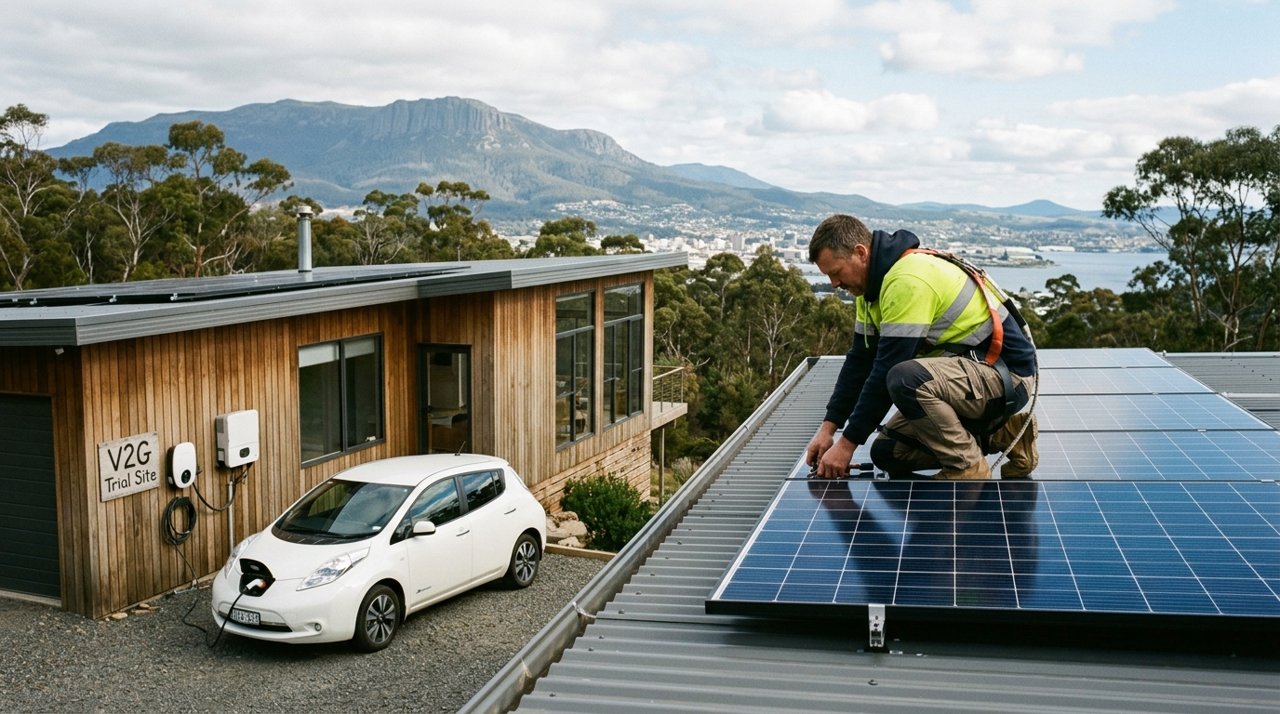
Yes — the technology exists and it works: a compatible electric vehicle with a bidirectional charger can discharge its battery to run your home, a setup known as vehicle-to-grid (V2G) or vehicle-to-home (V2H). But in Tasmania right now it is an emerging option rather than an off-the-shelf product, and for most households the proven path to lower bills is still rooftop solar sized for self-consumption.
That is the honest headline. The details below explain what V2G is, what stands between you and using it in Tasmania, and why the decision about solar shouldn’t wait for it.
What is vehicle-to-grid, and how is it different from a home battery?
A home battery is a fixed box on your wall that charges from your solar or the grid and discharges when you need it. V2G turns your car into a very similar device — except the “battery” is the one already sitting in your driveway, which is typically several times larger than a home battery.
The catch is that electricity normally flows one way: into the car. To get it back out you need two things working together:
- A vehicle that supports bidirectional charging. Only certain models do, and the technical standards are still maturing — older bidirectional cars used one plug standard, while most newer EVs use another that is only now gaining V2G capability.
- A bidirectional charger. This is different from the ordinary wall charger most EV owners install. Bidirectional units are only gradually reaching the Australian market, with limited models and installers experienced with them.
If either half is missing, the car simply charges like any other appliance.
Can I use V2G in Tasmania right now?
For most Tasmanian households, not yet in a practical sense. Compatible vehicles remain a minority of the EV fleet, bidirectional chargers are scarce, and any grid-connected discharge equipment needs network approval from TasNetworks just like a solar inverter does. There is also no vendor or retailer VPP-style program operating in Tasmania that would pay you to orchestrate your car battery, which removes one of the financial drivers V2G has on the mainland.
That doesn’t make V2G irrelevant — it makes it a “plan for it, don’t wait for it” technology. The cars and chargers will get more common, and the choices you make about solar today shape how ready your home is when they do.
Is an EV battery a substitute for a home battery?
Eventually it may be for some households, but today they solve different problems. A rough comparison:
| Home battery | EV with V2G | |
|---|---|---|
| Availability in Tasmania | Readily available now | Limited vehicles and chargers |
| Eligible for the federal battery rebate? | Yes, if paired with solar and eligible | No |
| Works when the car is at work/away? | Always available | Only when parked at home |
| Backup in a blackout | Straightforward with the right setup | Possible in principle, setup-dependent |
| Effect on the battery | Designed for daily cycling | Check your vehicle warranty terms |
One honest caution: using your car as a power station adds charge cycles to its battery. Vehicle warranties treat this differently, so it’s worth checking the fine print before counting on V2G for daily use.
So why does solar still come first?
Because in Tasmania, the maths rewards using your own solar power directly. The regulated feed-in tariff is modest — 9.276 c/kWh from 1 July 2026 — while the power you buy from the grid costs roughly 28–30 c/kWh. Every unit of solar you use yourself is therefore worth far more than every unit you export. Self-consumption, not export, is where the savings are.
That logic points to a system sized for your future, not just your past power bills. For homes planning to electrify — an EV, a heat pump, induction cooking — a system around 13 kW of panels on a 10 kW inverter has become the sensible default, a step up from the old 6.6 kW standard. TasNetworks permits a 10 kW single-phase inverter, so most homes don’t need three-phase power to do it. (A very low-use home with no battery, EV or electrification plans may still suit something smaller — one size honestly does not fit all.) The federal STC rebate discounts the upfront cost, with Tasmania falling in STC Zone 4.
As a rough guide rather than a promise, households often see solar paying for itself in the broad range of four to six years, depending on usage, tariff and how much solar is self-consumed. The same electrified home is also exactly the home that will get the most from V2G later: big daytime solar to fill the car, and a car ready to give it back overnight.
Where does a home battery fit in while V2G matures?
The federal Cheaper Home Batteries Program, running since 1 July 2025, takes roughly 30% off an eligible battery — around $250 per usable kWh at the full 2026 rate for the first 14 kWh, with lower rates on larger capacities up to a 50 kWh cap. The battery must be paired with solar, the discount tapers each year to 2030, and eligibility is never something to assume without checking. There is no separate Tasmanian state rebate.
Honesty matters here: Tasmania’s relatively cheap power and fair feed-in tariff mean a battery generally pays back more slowly than on the mainland — think in the broad range of seven to twelve years for the battery portion, depending on your circumstances. Wholesale spot-passthrough retailing does exist in Tasmania, and automated battery control can charge when spot prices go negative and sidestep peak imports — Solar Generation runs exactly this on its own systems — but for a typical household on a standard Aurora Energy tariff, the value is mainly self-consumption plus blackout backup. If a blackout-proof fridge, heating and lights matter to you, a battery delivers that today; V2G can’t yet.
Should I wait for V2G, or go solar now?
For most Tasmanian homes, go solar now and design with V2G in mind. Waiting means years of buying grid power at retail prices while a technology with no firm local timeline matures. A well-sized solar system starts working from day one, and nothing about it is wasted when V2G arrives — in fact, abundant cheap daytime solar is precisely what makes an EV-plus-V2G home powerful later.
If you’re buying an EV in the meantime, it’s reasonable to ask the dealer whether the model supports bidirectional charging, and to keep an eye on bidirectional chargers as they reach the Australian market. But treat V2G as a bonus your electrified home will be ready for — not a reason to delay the part that already stacks up.
The practical takeaway
In Tasmania today: size your solar for the home you’re becoming — roughly 13 kW of panels on a 10 kW single-phase inverter suits most electrifying households — prioritise using your own solar over exporting it, add a home battery if backup or the rebate maths works for you, and let V2G arrive when the cars, chargers and programs are genuinely ready.
This guide is written by the Tasmanian solar team at Solar Generation Tasmania — locals who are always happy to answer questions and help you think it through.
#solargentas #solargen #solargenerationtasmania
Published by Solar Generation Tasmania. General information current as at publication — rebates, tariffs and prices change, so confirm current figures before deciding.
Thinking about solar for your place?
Tell us a little about your home and a local Tasmanian installer will put together a free, no-obligation assessment — system, battery and the rebates you qualify for.
- Honest advice for Tasmanian conditions (Zone 4 sun, hydro grid)
- We apply every rebate you’re eligible for
- Local installers — not a mainland call centre
- SAA-accredited, with degree-qualified owners and 10+ years in tech & solar