
← Blog · 5 September 2026
The Aurora Plus App: Tracking Your Tasmanian Solar and Usage
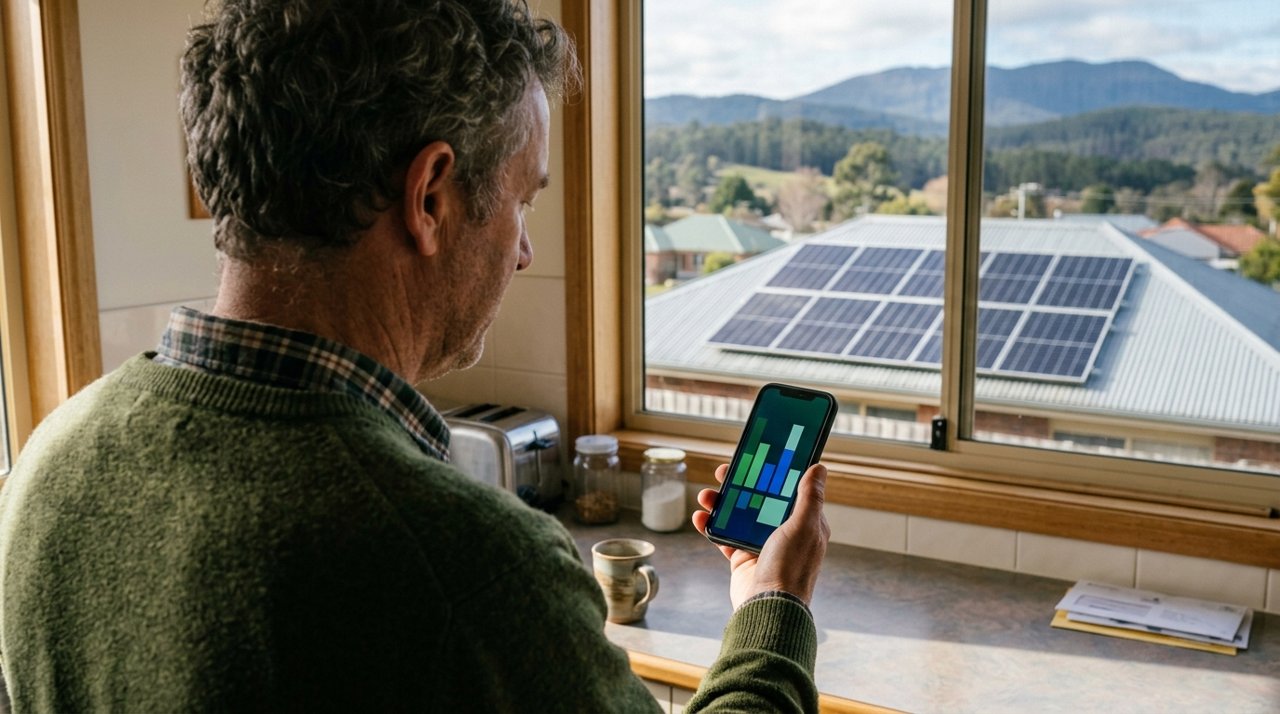
If you buy your power from Aurora Energy, the Aurora Plus app is the easiest free tool you have for understanding your electricity use — and once you add rooftop solar, it becomes the dashboard that tells you whether your system is actually working for you. In Tasmania, where the feed-in tariff is modest and grid power costs roughly three times as much, the real win from solar is using your own generation. The app is how you learn to do that.
What is the Aurora Plus app?
It’s Aurora Energy’s free customer app, and if your home has a smart meter it shows you how much electricity you’re using, when you’re using it, and an estimate of what it’s costing you. You don’t need solar to use it — but with panels on the roof, it becomes the simplest way to see your daily usage pattern and match it against the sun.
For most households the app’s value isn’t in any single screen. It’s in the habit of glancing at your usage over a few weeks and noticing the shape of your day: the overnight trickle from the fridge and standby loads, the morning spike, the evening peak when everyone’s home.
Why does self-consumption matter more than the feed-in tariff?
Because the maths strongly favours using your own solar power rather than selling it. Tasmania’s regulated feed-in tariff is 9.276 cents per kWh from 1 July 2026 (up from around 8.9 cents), while importing power from the grid costs roughly 28–30 cents per kWh — so every unit you use yourself is worth about three times every unit you export.
That single fact should shape almost every decision you make:
- Run big loads at midday. Dishwashers, washing machines, dryers and hot-water heating all have timers. Set them for the sunny hours.
- Charge the EV in daylight when you can. A car is the biggest flexible load most homes will ever have.
- Heat or cool the house before the evening peak. Let the sun do the work while it’s up.
- Watch the app for a fortnight after your system goes in. You’ll quickly see whether your usage lines up with your generation or leaks into expensive evening imports.
The feed-in tariff is still welcome — it credits you for genuine surplus — but treating it as the main reason to go solar gets the economics backwards.
What size solar system should I put on my roof?
For most Tasmanian homes that plan to electrify over the coming years — an EV, a heat pump, induction cooking — a system of around 13 kW of panels on a 10 kW inverter is the sensible, future-proof default. That’s a step up from the old 6.6 kW standard, and most homes do not need three-phase power to do it.
The 13-on-10 arrangement takes advantage of the common 133% inverter oversizing rule, and TasNetworks allows a 10 kW single-phase inverter in Tasmania, which keeps the switchboard work simpler. The federal STC rebate under the Small-scale Renewable Energy Scheme discounts the upfront cost of eligible systems — Tasmania sits in STC Zone 4 — provided the system and installation meet the scheme’s rules.
| Household | Typical fit | Why |
|---|---|---|
| Low use, no EV or electrification plans | A smaller system may suit | Little daytime load to soak up surplus generation |
| Average home, some electrification ahead | ~13 kW panels / 10 kW inverter | Headroom for an EV and heat pump without upgrading later |
| Large home, pool, two EVs | Discuss options with your installer | Site, roof space and network rules set the ceiling |
As a rough guide only — never a guarantee — many households see a solar payback in the order of four to six years, depending heavily on how much of their generation they use themselves, the installed price, and how their habits change after they start watching the app.
Should I add a home battery in Tasmania?
Honest answer: batteries pay back more slowly in Tasmania than on the mainland, because our grid power is relatively affordable and our feed-in tariff is fair — the gap a battery exploits is narrower here. For a typical Aurora-tariff household, a battery’s value is mainly extra self-consumption plus blackout backup, and a payback in the order of seven to twelve years is a realistic planning range, depending on your usage and the installed price.
The federal Cheaper Home Batteries Program, running since 1 July 2025, takes roughly 30% off an eligible battery — about $250 per usable kWh at the 2026 full rate for the first 14 kWh, stepping down to 60% for 14–28 kWh and 15% for 28–50 kWh, with a 50 kWh cap. The discount tapers each year to 2030, the battery must be paired with solar, and eligibility depends on the product and installation meeting the program’s requirements. There is no separate Tasmanian state battery rebate.
A few more honest points:
- No vendor or retail VPP program currently operates in Tasmania, so don’t count on virtual-power-plant income.
- Wholesale spot-price exposure does exist through spot-passthrough retailing. With automated control, a battery can charge when spot prices go negative and dodge peak imports — Solar Generation runs exactly this kind of automation on its own systems — but it suits engaged households comfortable with variable pricing.
- If blackout protection is your main motive, that’s a legitimate reason on its own; just go in with clear eyes about the financial return.
What if my home uses very little power?
Then a smaller system — or even waiting — may be the right call, and any honest advice should say so. If your bills are already low, you have no EV, no battery, and no plans to electrify heating or cooking, a large system would mostly export at feed-in rates. The app is useful here too: check a few months of usage history before you size anything, and let your real numbers, not a salesperson’s default, drive the decision.
What’s the one habit worth building?
Check the app once a week. That’s it. Look at when your usage peaks, shift one appliance into the sunny middle of the day, and check again next week. Solar in Tasmania rewards attention more than it rewards hardware: the households that get the most from their systems are usually the ones that simply learned their own pattern and moved their loads to match the sun. Everything else — system size, batteries, tariffs — flows from that understanding.
This guide is written by the Tasmanian solar team at Solar Generation Tasmania as a free community resource; we’re always happy to answer questions from fellow Tasmanians working out their next step.
#solargentas #solargen #solargenerationtasmania
Published by Solar Generation Tasmania. General information current as at publication — rebates, tariffs and prices change, so confirm current figures before deciding.
Thinking about solar for your place?
Tell us a little about your home and a local Tasmanian installer will put together a free, no-obligation assessment — system, battery and the rebates you qualify for.
- Honest advice for Tasmanian conditions (Zone 4 sun, hydro grid)
- We apply every rebate you’re eligible for
- Local installers — not a mainland call centre
- SAA-accredited, with degree-qualified owners and 10+ years in tech & solar