
← Blog · 7 September 2026
Solar Payback Periods in Tasmania: The Real Numbers Explained Simply
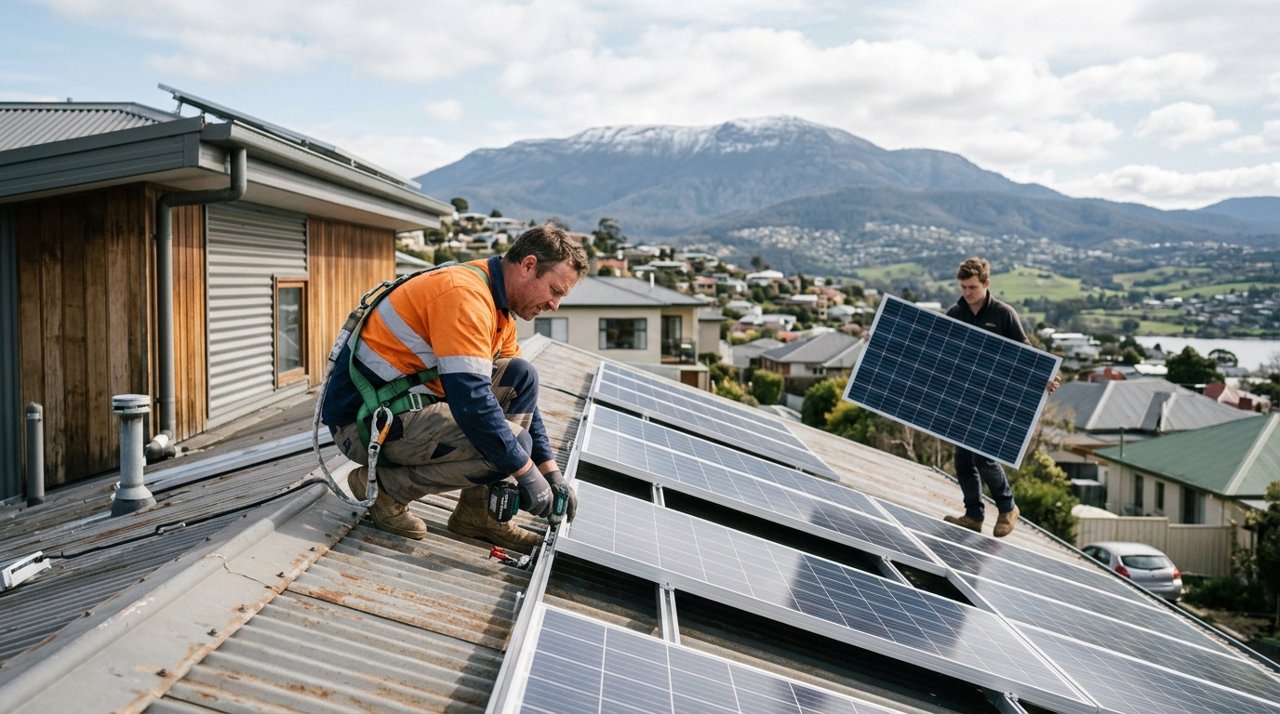
Going solar in Tasmania usually pays for itself in the medium term rather than overnight — most households see a payback in the broad range of several years, with batteries taking longer. The biggest savings come from using your own solar power in the home rather than exporting it, because the feed-in tariff is much lower than what you pay for grid power.
How long does solar actually take to pay back in Tasmania?
For a typical Tasmanian household, a well-matched solar system commonly pays for itself in roughly 4–6 years, though your actual result depends on how much of your own solar you use, your system size, your roof, and your tariff. Homes that use more power during the day tend to sit at the faster end of that range.
That range is a general guide, not a promise. Two identical systems on neighbouring homes can pay back at quite different speeds if one family runs the dishwasher, heat pump and washing machine during daylight hours and the other uses most of its power after dark.
Why does self-consumption matter more than the feed-in tariff?
Because the gap between the two prices is large. Aurora Energy, the main residential retailer, pays a regulated feed-in tariff of 9.276 c/kWh from 1 July 2026 (up from about 8.9 c), while the power you buy from the grid costs roughly 28–30 c/kWh. Every unit you use yourself saves you the full retail price; every unit you export earns you about a third of that.
In practical terms:
- A solar unit used in the home is worth roughly 28–30 c to you.
- The same unit exported is worth about 9.3 c.
- So self-consumed solar can be worth around three times exported solar.
This is why running appliances during the day — and why bigger electrified loads like EVs and heat pumps — improve payback so much.
What size system should a Tasmanian home get?
For most homes planning to electrify, around 13 kW of panels on a 10 kW inverter is the sensible modern default, replacing the old 6.6 kW standard. That pairing uses the 133% inverter oversizing rule, and TasNetworks permits a 10 kW single-phase inverter in Tasmania, so most homes do not need three-phase power.
The logic is simple: panels are the cheap part of the job, and future loads — an EV, a heat pump, induction cooking — will use the extra capacity. A slightly larger system also keeps producing useful power through Tasmania’s cloudy winters.
That said, honesty matters here: if your household uses very little power and you have no battery, EV or electrification plans, a smaller system may suit you better. Bigger is only better if you will actually use the energy.
What rebates actually reduce the cost?
Two federal programs do most of the heavy lifting, and there is no separate Tasmanian state battery rebate:
- The federal STC rebate (Small-scale Renewable Energy Scheme) discounts the upfront cost of solar. Tasmania sits in STC Zone 4. The discount is applied through your installer’s paperwork rather than paid to you directly, and eligibility depends on the system and installation meeting scheme requirements.
- The Cheaper Home Batteries Program (from 1 July 2025) takes roughly 30% off an eligible battery — approximately $250 per usable kWh in 2026 at the full rate for the first 14 kWh, then 60% of that rate for 14–28 kWh and 15% for 28–50 kWh, capped at 50 kWh. The battery must be paired with solar, the rate tapers each year to 2030, and eligibility depends on the battery and installation meeting program rules.
Neither rebate is guaranteed for every home or product — check current eligibility before counting on either.
Is a home battery worth it in Tasmania?
Batteries pay back more slowly in Tasmania than on the mainland — commonly in the broad range of 7–12 years depending on your usage and tariff. Our relatively cheap power and fair feed-in tariff mean a battery saves less per unit here than in states with expensive electricity and stingy exports.
For a typical household on a standard Aurora tariff, a battery’s value is mainly:
- storing your own solar for evening use (self-consumption), and
- keeping the lights on during outages.
No vendor or retail VPP program currently operates in Tasmania. Wholesale-price exposure does exist through spot-passthrough retailing, where automated battery control can charge when spot prices go negative and avoid expensive peak imports — Solar Generation runs exactly this on its own systems — but it is a different style of plan and not for everyone. Whether a battery stacks up for you depends on your tariff, your evening usage and how much you value backup, so treat any payback estimate as conditional on those factors.
How do the options compare at a glance?
| Option | Rough payback guide* | Best suited to |
|---|---|---|
| Smaller system (e.g. ~6.6 kW), no battery | Often several years | Low-use homes with no electrification plans |
| ~13 kW panels on 10 kW inverter, no battery | Commonly ~4–6 years | Most homes, especially those adding EV/heat pump |
| Solar plus battery | Battery portion often ~7–12 years | Homes wanting evening self-use and blackout backup |
*General ranges only — real results depend on your usage, roof, tariff and system price.
What should you do before deciding?
Work out when you use power, not just how much. Check a few power bills for your daily usage pattern, think about what you plan to electrify over the next decade, and size the system for that future rather than for yesterday’s bills. If most of your usage is after dark, either plan to shift loads into daylight or factor a battery — and its longer payback — into your thinking.
The single most useful thing you can do today costs nothing: for one week, note which appliances run when, and imagine them running on sunshine instead. That picture of your own household is worth more than any generic payback calculator.
This guide is written by the Tasmanian solar team at Solar Generation Tasmania as a free community resource — if you have questions about how any of this applies to your home, they’re always happy to help you think it through.
#solargentas #solargen #solargenerationtasmania
Published by Solar Generation Tasmania. General information current as at publication — rebates, tariffs and prices change, so confirm current figures before deciding.
Thinking about solar for your place?
Tell us a little about your home and a local Tasmanian installer will put together a free, no-obligation assessment — system, battery and the rebates you qualify for.
- Honest advice for Tasmanian conditions (Zone 4 sun, hydro grid)
- We apply every rebate you’re eligible for
- Local installers — not a mainland call centre
- SAA-accredited, with degree-qualified owners and 10+ years in tech & solar