
← Blog · 8 September 2026
Solar Panels in Tasmania's Cold Climate: What Actually Happens Explained Simply
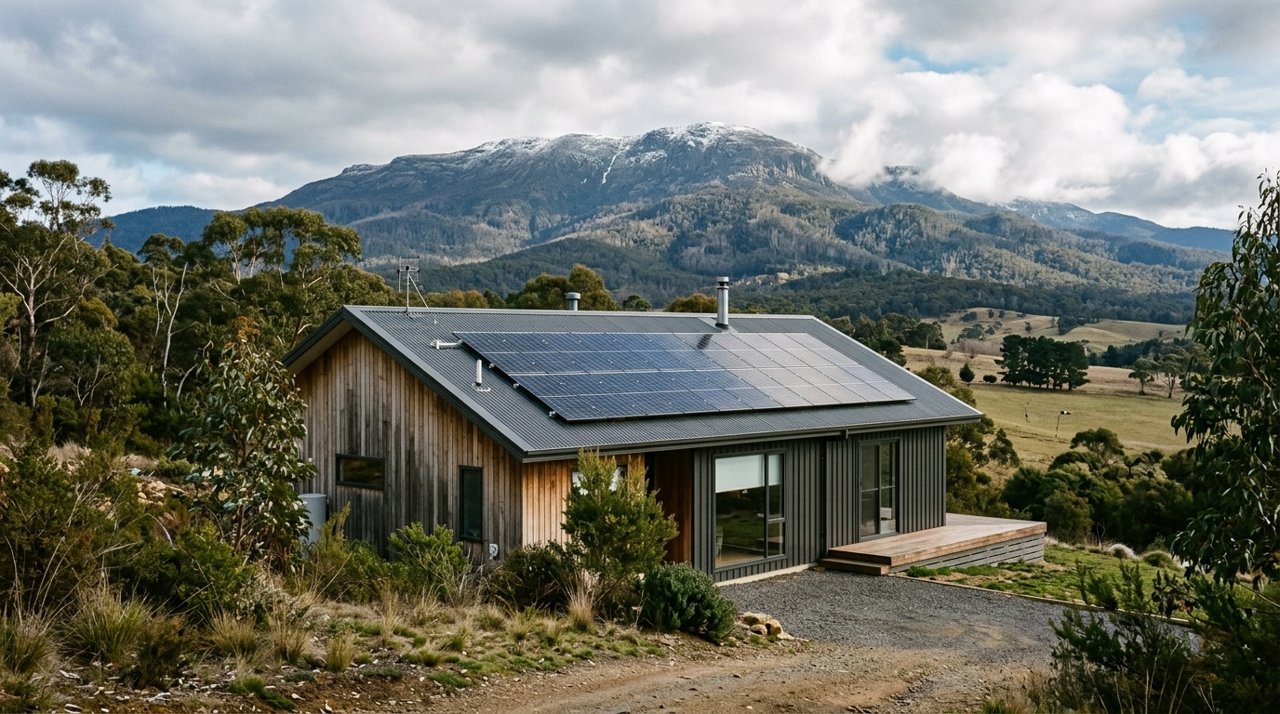
Yes — solar panels work well in Tasmania’s cold climate, and in a few surprising ways the cold actually helps. Panels make electricity from light, not heat, so a crisp, clear Tassie day is genuinely good generating weather. The honest trade-off is winter daylight: shorter days mean lower output in the cooler months, balanced by long, strong summer days. Here’s what that means for your home, your bills, and whether a battery makes sense.
Do solar panels actually work in cold weather?
Yes — and they often work better in the cold. Solar panels convert sunlight into electricity, and like most electronics they run more efficiently when they’re cool rather than hot. A frosty Tasmanian morning followed by sunshine is no problem at all; frost on the glass simply melts away once the sun hits it.
What does reduce output is cloud cover and short days — not temperature. So while Hobart’s July output will be lower than its January output, that’s about daylight hours, not the cold doing anything harmful to your system.
How much does solar output drop in a Tasmanian winter?
Expect noticeably less generation in winter than summer — that’s normal everywhere in Australia, and it’s more pronounced the further south you go. Days are shorter, the sun sits lower, and there’s more cloud around. A well-designed system is sized with this seasonal swing in mind, so your yearly figures still stack up even though June looks modest next to December.
Practically, winter is when daytime habits matter most:
- Run the dishwasher, washing machine and dryer during daylight hours
- Set hot water and heat pumps to work hardest while the sun is up
- Charge devices and top up the EV in the middle of the day where possible
Every unit you use while the sun shines is a unit you don’t buy from the grid.
Is the solar feed-in tariff worth much in Tasmania?
It’s fair, but modest — and that shapes the whole economics of going solar here. Aurora Energy, the main residential retailer, has a regulated feed-in tariff of 9.276 c/kWh from 1 July 2026 (up from about 8.9 c/kWh), while the power you buy from the grid costs roughly 28–30 c/kWh.
| What happens to a unit of your solar | What it’s roughly worth to you |
|---|---|
| You use it yourself instead of buying power | Avoids paying around 28–30 c/kWh |
| You export it to the grid | Earns the feed-in tariff, around 9.3 c/kWh |
The takeaway is simple: self-consumption is where the savings are, not export. Solar pays off fastest in homes that use a good share of their own generation — which is exactly why daytime habits and sensible system sizing matter more than chasing feed-in rates.
What size solar system should a Tasmanian home get?
For most households planning to electrify — an EV, a heat pump, induction cooking — a system around 13 kW of panels on a 10 kW inverter has become the sensible, future-proof default. That’s a big step up from the old 6.6 kW standard, and it works because of the 133% inverter oversizing rule: you’re allowed roughly a third more panel capacity than inverter capacity. TasNetworks permits a 10 kW single-phase inverter in Tasmania, so most homes do not need an expensive three-phase upgrade.
The federal STC rebate (under the Small-scale Renewable Energy Scheme) discounts the upfront cost of eligible systems — Tasmania sits in STC Zone 4 — though the exact benefit depends on your system and eligibility under the scheme’s rules.
One honest caveat: a very low-use home with no battery, no EV and no electrification plans may be better served by a smaller system. Bigger is only better if you’ll actually use the power. As a rough guide — not a guarantee — many Tasmanian households find solar pays for itself in something like four to six years, depending heavily on how much of their own solar they use, their tariff, and their usage patterns.
Is a home battery worth it in Tasmania?
Sometimes — but be honest with yourself about the payback, because Tasmania’s relatively cheap power and fair feed-in tariff make batteries pay back more slowly here than on the mainland. For many homes, the battery portion of a system takes considerably longer to pay for itself than the panels — often somewhere in the seven-to-twelve-year range, depending on your usage and tariff.
The federal Cheaper Home Batteries Program, running since 1 July 2025, takes about 30% off an eligible battery — roughly $250 per usable kWh in 2026 at the full rate for the first 14 kWh, stepping down to 60% for 14–28 kWh and 15% for 28–50 kWh, capped at 50 kWh. It tapers each year until 2030, the battery must be paired with solar, and — as with any government program — eligibility depends on the scheme’s rules. There is no separate Tasmanian state battery rebate.
No vendor or retail VPP program currently operates in Tasmania. Wholesale spot-passthrough retailing does exist, though, and automated battery control can charge when spot prices go negative and avoid peak imports — Solar Generation runs exactly this on its own systems. For a typical household on a standard Aurora tariff without spot exposure, a battery’s real value is storing your own solar for evening use, plus the comfort of backup during outages — something Tassie’s storm season makes genuinely appealing.
What about frost, hail and wild Tassie weather?
Modern panels are built and tested to handle Australian conditions, including hail, heavy rain and high winds, and a quality installation is designed for local weather. Cold itself doesn’t harm panels — if anything, they prefer it. The main weather question worth asking any installer is about mounting, fixings and workmanship warranties, because those matter more over 25 years than the odd frost ever will.
The bottom line
Solar works well in Tasmania’s cold climate — the cold helps, and the only real compromise is shorter winter days. The single most useful thing you can do is shift your electricity use into daylight hours, size your system for the home you’re becoming (EV, heat pump, induction), and treat a battery as a comfort-and-backup decision rather than a quick financial win.
This guide is written by the Tasmanian solar team at Solar Generation Tasmania — locals who are always happy to answer questions and help you make sense of your options.
#solargentas #solargen #solargenerationtasmania
Published by Solar Generation Tasmania. General information current as at publication — rebates, tariffs and prices change, so confirm current figures before deciding.
Thinking about solar for your place?
Tell us a little about your home and a local Tasmanian installer will put together a free, no-obligation assessment — system, battery and the rebates you qualify for.
- Honest advice for Tasmanian conditions (Zone 4 sun, hydro grid)
- We apply every rebate you’re eligible for
- Local installers — not a mainland call centre
- SAA-accredited, with degree-qualified owners and 10+ years in tech & solar