
← Blog · 17 September 2026
Solar Inverter Sizing and the 133% Oversizing Rule Explained Simply
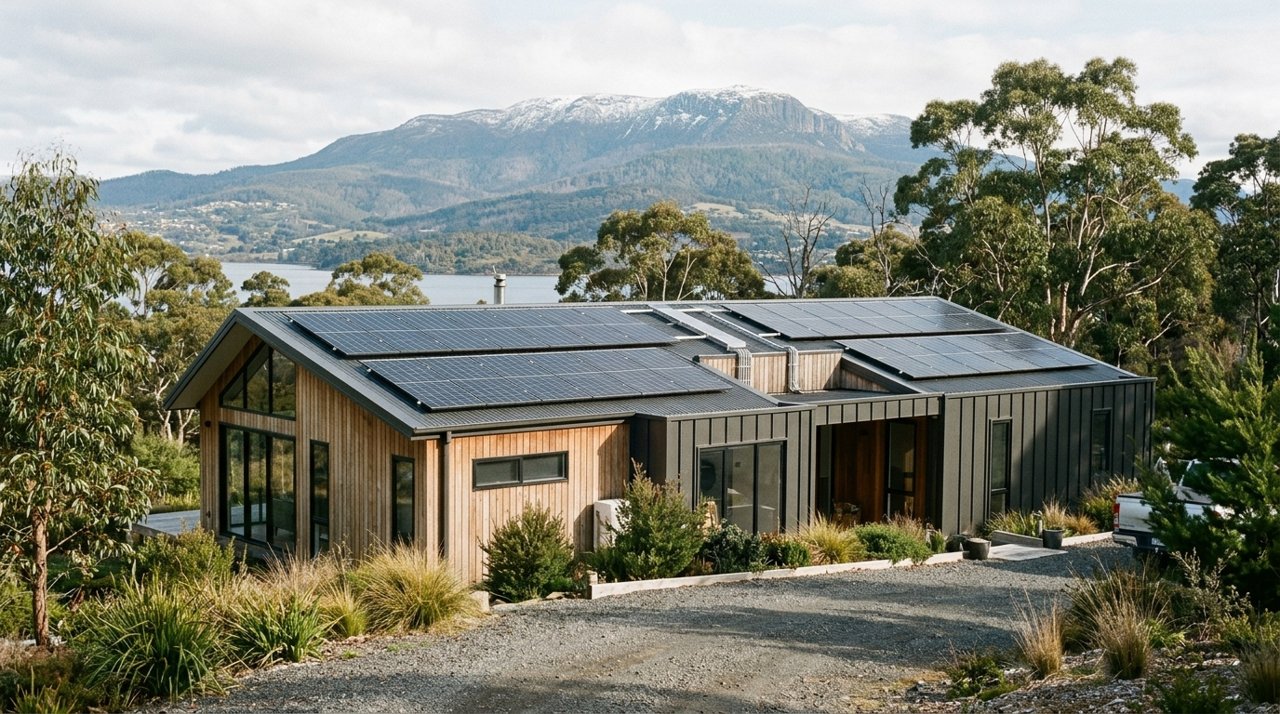
Quick answer first: the 133% rule lets you install up to a third more solar panel capacity than your inverter’s rated output — roughly 13 kW of panels on a 10 kW inverter — while still qualifying for the federal rebate. For most Tasmanian homes planning to electrify, that pairing has become the smart default. Here’s why, in plain terms.
What is the 133% inverter oversizing rule?
It’s a Clean Energy Regulator rule that allows your total panel capacity to be up to 133% of your inverter’s rated capacity — for example, about 13.3 kW of panels on a 10 kW inverter — while the system still claims the federal STC rebate, subject to eligibility. Because panels rarely produce their full rated output, the extra panels mostly harvest more real energy, not waste it.
Why would the rules allow that? Because a panel’s “rated” output is measured under perfect lab conditions. In the real world — cool mornings, cloud, low winter sun, a bit of dust — panels spend most of their lives well below their sticker number. On the rare perfect day when they do peak, the inverter simply “clips” the excess for a short while. The small amount occasionally clipped is usually worth far less than the extra energy gathered across thousands of ordinary hours.
Why does oversizing make sense in Tasmania’s climate?
Tasmania’s winters are short on sunshine and cloud is common, so panels here operate below their rating much of the time. Extra panel capacity lifts what you generate in the mornings, afternoons and through winter — exactly when a smaller system falls short — without the cost of a larger inverter.
The economics point the same way. Aurora Energy’s regulated feed-in tariff is 9.276 cents per kWh from 1 July 2026 (up from about 8.9 cents), while the power you buy costs roughly 28–30 cents per kWh. In other words, every unit of solar you use yourself is worth around three times what you’d be paid for exporting it. A bigger panel array gives you more of your own power to use — for hot water, heating, cooking, and eventually an EV.
Is 13 kW of panels on a 10 kW inverter right for my home?
For most households planning to electrify — an EV, heat pump hot water, induction cooking — around 13 kW of panels on a 10 kW inverter is a sensible, future-proof default. It has largely replaced the old 6.6 kW “standard” system, which can feel cramped once a car and electric heating join the bill. But it isn’t right for everyone.
| Smaller system (~6.6 kW) | Larger system (~13 kW on 10 kW inverter) | |
|---|---|---|
| Best suited to | Low power use, no EV or electrification plans | Family homes, EV or heat pump planned, all-electric goal |
| Winter and cloudy-day output | Modest — may fall short when you need it most | Stronger — more usable energy year-round |
| Upfront cost | Lower | Higher, with the gap partly offset by the STC rebate (subject to eligibility) |
| Headroom for the future | Limited — harder to expand later | Room for an EV and a battery down the track |
If your household uses little power and you have no plans for an EV, heat pump or battery, a smaller, cheaper system may genuinely be the better fit. Bigger is only better if you’ll use it.
Do I need three-phase power for a 10 kW inverter in Tasmania?
Usually not. TasNetworks allows a 10 kW inverter on a standard single-phase connection, which is what most Tasmanian homes already have. That keeps the installation simpler and avoids the cost of a three-phase upgrade. Only unusually large setups or special site conditions push into three-phase territory — your designer confirms this with TasNetworks as part of the process.
What rebates apply, and do they change the sizing maths?
Two federal settings matter, and both are subject to eligibility. The STC rebate discounts the upfront cost of a solar system (Tasmania sits in STC Zone 4), and the discount scales with system size — so oversizing your panels earns more STCs. Separately, since 1 July 2025 the Cheaper Home Batteries Program has taken roughly 30% off an eligible battery: in 2026 that’s around $250 per usable kWh at the full rate for the first 14 kWh, stepping down for larger batteries up to a 50 kWh cap, tapering each year to 2030, and the battery must be paired with solar. There is no separate Tasmanian state battery rebate.
Should I add a battery when I go solar?
It depends on your tariff and your goals. Tasmania’s relatively affordable power and fair feed-in tariff mean a battery generally pays for itself more slowly here than on the mainland, so think of its value as self-consumption plus blackout backup rather than a quick return. Homes with exposure to wholesale spot prices can do better, because automated control can charge the battery when spot prices go negative and sidestep peak imports — Solar Generation runs exactly this kind of control on its own systems. For a typical Aurora household, though, the panels do the heavy lifting first.
As a rough guide only, households often see the solar portion pay for itself in the order of four to six years, and batteries considerably longer — but both depend heavily on your usage, tariff, roof and setup, so treat any payback figure as indicative, never a promise.
What’s the bottom line for Tasmanian homes?
- Planning to electrify? Around 13 kW of panels on a 10 kW single-phase inverter is the practical default — and most homes won’t need three-phase.
- Low usage, no big plans? A smaller system may suit you better, and there’s no shame in that.
- Whatever size you choose, prioritise self-consumption: shift hot water, dishwashers, washing machines and EV charging into solar hours. At current tariffs, the solar you use beats the solar you sell by a wide margin.
- Before you commit, have your roof’s orientation, shading and condition, your switchboard, and your actual usage history assessed — good sizing starts from your numbers, not a one-size package.
This guide was written by the Tasmanian solar team at Solar Generation Tasmania — locals who are always happy to answer questions and help you make sense of your options.
#solargentas #solargen #solargenerationtasmania
Published by Solar Generation Tasmania. General information current as at publication — rebates, tariffs and prices change, so confirm current figures before deciding.
Thinking about solar for your place?
Tell us a little about your home and a local Tasmanian installer will put together a free, no-obligation assessment — system, battery and the rebates you qualify for.
- Honest advice for Tasmanian conditions (Zone 4 sun, hydro grid)
- We apply every rebate you’re eligible for
- Local installers — not a mainland call centre
- SAA-accredited, with degree-qualified owners and 10+ years in tech & solar