
← Blog · 4 September 2026
Sigenergy Solar and Battery Systems: A Tasmanian Guide
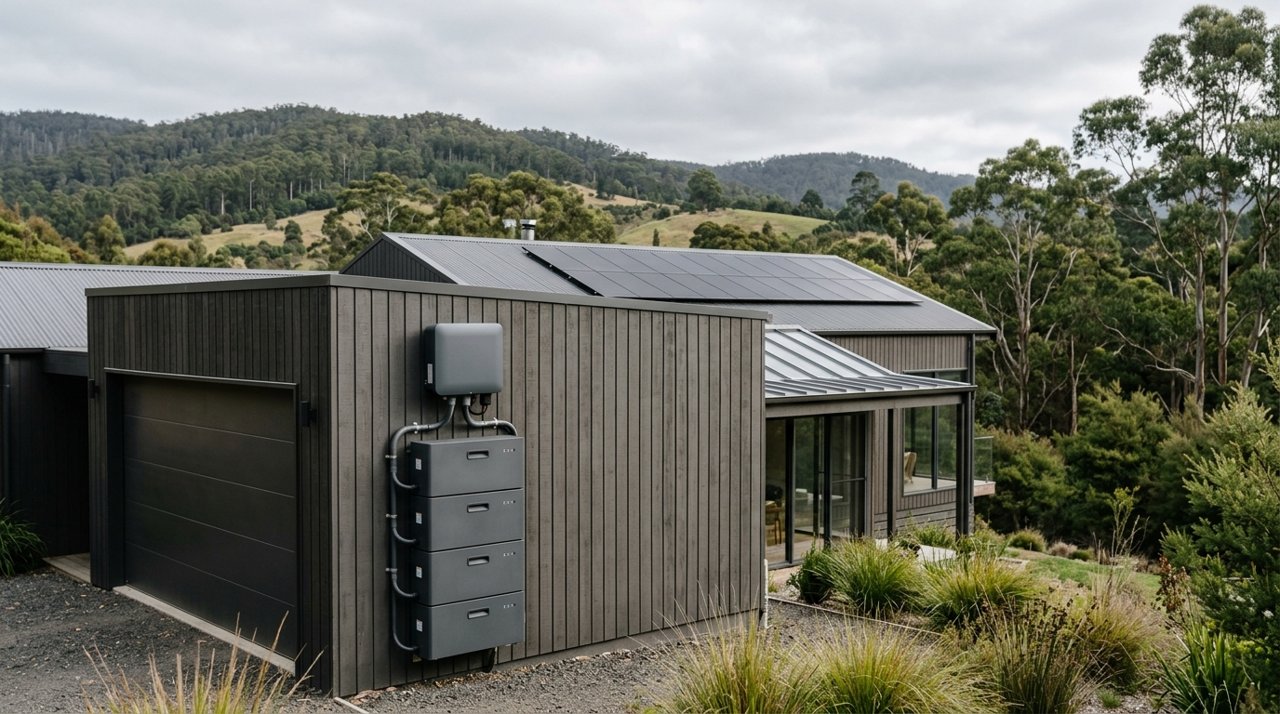
Yes — for most Tasmanian homes, solar remains one of the more reliable ways to cut a power bill. The maths has shifted, though: the savings now come mainly from using your own solar power at home (self-consumption), not from exporting it to the grid.
Here’s why. Aurora Energy, the main residential retailer, pays a regulated feed-in tariff of 9.276 cents per kWh (from 1 July 2026, up from about 8.9 cents), while the power you buy costs roughly 28–30 cents per kWh. Every unit of solar you use yourself avoids buying at the higher price; every unit you export earns the lower one. That gap is the whole story — a system earns its keep when the household runs heating, hot water, appliances or an EV while the sun is shining.
What size solar system should a Tasmanian home get?
For most homes that plan to electrify — an EV, a heat pump, induction cooking — around 13 kW of panels on a 10 kW inverter is the sensible, future-proof default. A smaller system can still be the better fit for low-use households with no electrification plans.
The old 6.6 kW default was sized for a world of modest daytime use. Modern all-in-one systems, including Sigenergy’s, are designed around bigger arrays because homes are steadily going all-electric. Panels are the cheapest part of a system, and the 133% oversizing rule allows about 13 kW of panels on a 10 kW inverter — giving stronger winter and morning output, which matters in Tasmania’s climate.
Be honest about your own usage, though. If your bills are modest, you’re not planning an EV or battery, and the house sits empty most days, a smaller, cheaper system may well pay back sooner. Bigger is only better if you’ll actually use the power.
Do I need three-phase power for a system that size?
Usually not. TasNetworks allows a 10 kW inverter on a standard single-phase connection in Tasmania, which comfortably covers the roughly 13 kW system described above — so most homes can go big on the wiring they already have.
Three-phase can still make sense in some situations, such as very large systems or certain rural properties, but it’s an upgrade cost many households simply don’t need to pay.
Is a battery worth adding in Tasmania?
Sometimes — and it’s worth going in with clear eyes. A battery lifts your self-consumption, keeps essentials running during outages, and, on the right retail plan, can take advantage of cheap or even negative wholesale prices. For a typical Aurora household, though, payback is generally slower here than on the mainland.
Tasmania’s relatively cheap power and comparatively fair feed-in tariff narrow the gap a battery can exploit. As a rough guide only, solar on its own often pays for itself in the order of four to six years, while the battery portion can take considerably longer — in the order of seven to twelve years — depending heavily on your usage, tariff and setup. Outage backup has genuine value too, especially in regional areas, even if it’s hard to put a dollar figure on peace of mind.
What rebates are available for Tasmanian households?
Two federal programs do most of the work: the STC rebate for solar and the Cheaper Home Batteries Program for storage. There is no separate Tasmanian state battery rebate, and eligibility for both programs is subject to conditions — treat them as likely discounts, never guarantees.
- STC rebate (SRES): discounts the upfront cost of eligible solar systems. Tasmania sits in STC Zone 4, and the discount is usually applied at the point of sale.
- Cheaper Home Batteries Program (from 1 July 2025): for eligible batteries paired with solar, it takes roughly 30% off — in 2026, around $250 per usable kWh at the full rate for the first 14 kWh of capacity, stepping down to about 60% of the full rate for 14–28 kWh and about 15% for 28–50 kWh, with a 50 kWh cap. The rates taper each year through to 2030, and the battery must be paired with solar.
Can I sell power back, or join a VPP?
You can export and earn the regulated feed-in tariff, but there is currently no vendor- or retailer-run Virtual Power Plant (VPP) program operating in Tasmania. What does exist is wholesale spot-price exposure through spot-passthrough retail plans — and that’s where smart batteries get interesting.
On a spot-passthrough plan, prices sometimes fall very low or even negative, typically on sunny, windy middays. An automated battery can charge when prices are low or negative and avoid buying at peak times. Solar Generation runs exactly this kind of setup on its own systems. It isn’t for everyone — spot prices cut both ways — but for engaged households it can meaningfully improve battery economics. For a typical flat-tariff Aurora home, the battery’s value remains self-consumption plus backup.
Where does a Sigenergy system fit in?
Sigenergy’s appeal is the all-in-one approach: solar inverter, battery storage and energy management designed to work together in a single integrated system, with battery capacity that can be added at install or in stages later. That suits Tasmanian homes wanting solar now and the option to electrify further over time.
Rather than mixing separate inverter and battery brands, everything is built to operate as one system and is monitored through a single app. For a household thinking “solar today, battery and EV charging over the next few years”, that kind of modularity matches how electrification actually happens — step by step, as budgets allow.
Which setup suits which household?
| Your situation | Sensible starting point |
|---|---|
| Low usage, no EV or electrification plans | Smaller solar-only system |
| Average household planning to electrify | Around 13 kW of panels on a 10 kW inverter, battery-ready |
| Higher usage, or frequent outages | Larger solar system plus battery from day one |
| Comfortable with automation and spot prices | Battery on a wholesale spot-passthrough retail plan |
What’s the practical takeaway?
Size your solar for the home you’re becoming, not just the home you are today — if electrification is on your horizon, a bigger single-phase system is usually the smart default, while genuinely low-use homes can still do well with less. Use as much of your own solar as you can, treat a battery as a longer-term investment in self-consumption and backup rather than a quick win, and check current rebate settings and your eligibility before you commit, because both change over time.
This guide is written by the Tasmanian solar team at Solar Generation Tasmania as a free community resource — we’re always glad to help fellow Tasmanians with questions as they work out their own path.
#solargentas #solargen #solargenerationtasmania
Published by Solar Generation Tasmania. General information current as at publication — rebates, tariffs and prices change, so confirm current figures before deciding.
Thinking about solar for your place?
Tell us a little about your home and a local Tasmanian installer will put together a free, no-obligation assessment — system, battery and the rebates you qualify for.
- Honest advice for Tasmanian conditions (Zone 4 sun, hydro grid)
- We apply every rebate you’re eligible for
- Local installers — not a mainland call centre
- SAA-accredited, with degree-qualified owners and 10+ years in tech & solar