
← Blog · 4 October 2026
How to Tell if a Solar Company Is Reputable — or About to Go Bust
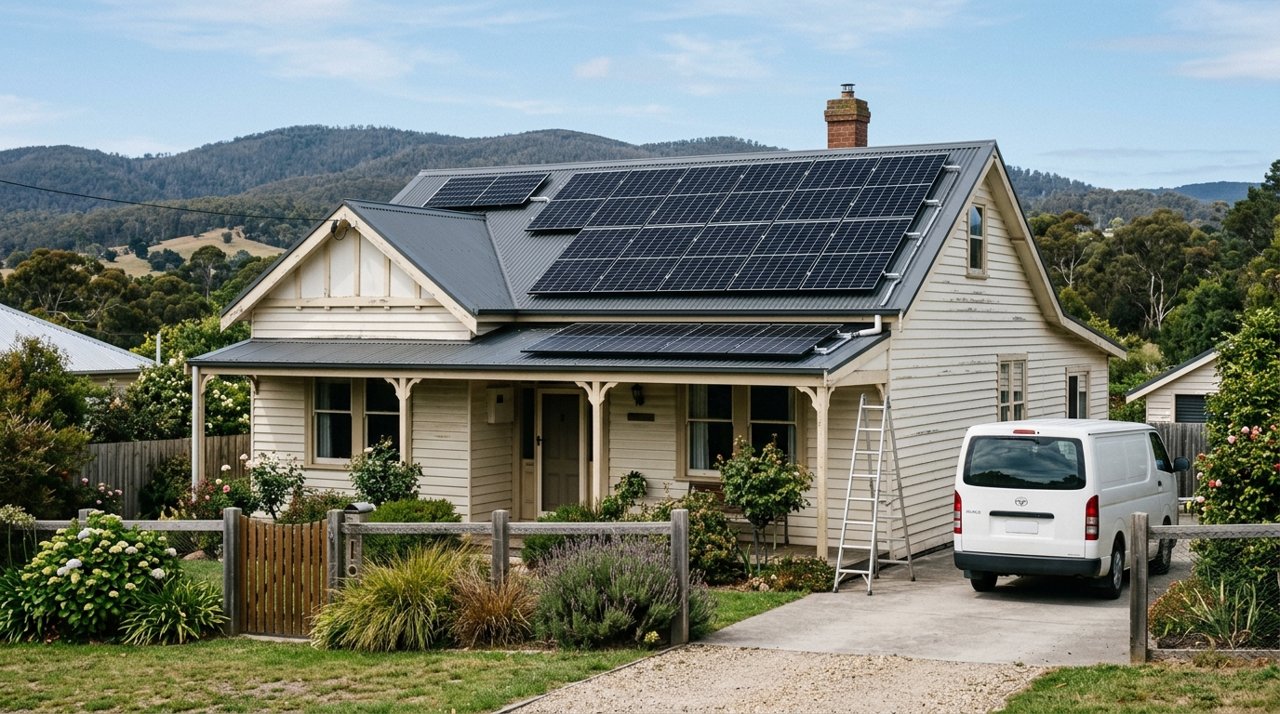
Buying rooftop solar is one of the few household purchases where you are quietly betting on a company still existing in a decade. Panel performance warranties usually run 25 years. Installer workmanship warranties usually run about five. Somewhere in between sits the question nobody enjoys asking: will these people still be here when I need them?
It is a fair question to ask. ASIC’s insolvency figures show about 14,150 companies entered external administration for the first time in 2025–26, down slightly from 14,722 the year before, and construction was the hardest-hit industry with 3,472 companies, or 24.5% of the total. ASIC does not report solar businesses separately, so be sceptical of anyone quoting you a solar-specific collapse count. The broader picture is reason enough to spend twenty minutes doing homework before you sign.
Here is how to do that homework from your kitchen table, whether you are in Hobart, Launceston or well out in the regions.
How do I check a solar installer is actually accredited?
Check the person, not the business. Solar Accreditation Australia (SAA) now runs accreditation for solar and battery installers and designers under the federal Small-scale Renewable Energy Scheme. Its website has an “Is my installer accredited?” search by name or accreditation number. Look up the individual who will design and install your system.
This matters for your wallet, not just your peace of mind: a system has to be designed and installed by an SAA-accredited person to earn STCs, the upfront federal rebate that discounts the purchase price. No accreditation, no rebate.
Two things worth knowing. First, the Clean Energy Regulator chose SAA in February 2024 and all accreditation moved across by 29 May 2024 — the Clean Energy Council no longer runs installer accreditation, so a website still boasting about CEC-accredited installers simply hasn’t been updated. Second, SAA accredits individuals, not companies, and accreditation speaks to training and competence. It tells you nothing at all about whether the business is solvent.
What does the New Energy Tech Consumer Code badge actually prove?
It proves the business has signed up to a voluntary code of conduct — a good sign, not proof it is financially sound. The New Energy Tech Consumer Code (NETCC) is administered by the Clean Energy Council, and signatories are called “Approved Sellers”. The ACCC recorded 2,331 signatories by August 2026. You can check a business using “Find an Approved Seller” at newenergytech.org.au.
The standards are genuinely useful and include:
- no pressure selling
- a written quote that states any deposit
- a written contract setting out the warranties
- a receipt for any deposit you pay
- a complaints-handling process
- residential finance only through a licensed credit provider or an approved arrangement
Now the honest limits, which the ACCC itself noted when it re-authorised an updated Code on 28 August 2026 (the new version takes effect 1 December 2026): there is no independent external dispute resolution under the Code, audits rely heavily on self-reported questionnaires, some signatories resign while under investigation, 11 signatories had been expelled by February 2026, and authorisation is not an endorsement. Treat the badge as one input among several.
What paperwork does a legal solar job need in Tasmania?
Start with the electrical contractor licence. Anyone selling electrical services to the public in Tasmania needs one, and the bar is relevant to your question: to hold a licence the business must be “fit and proper”, show a strong and stable financial background, and hold at least $5 million of insurance per incident. That screening is one of the better financial signals available to you.
Check it yourself on the government’s “Find a licensed tradesperson” register under the category Electrician — note it lists current licence holders only. On the day, the electrician should be able to show you a licence card.
Non-trivial electrical work also needs a Certificate of Electrical Compliance lodged with TechSafe Australia, the government-funded inspector, which may come and inspect the job. TechSafe found the ten most common solar defects made up about 65% of all solar defects it recorded in 2025, with examples including missing system layout plans and mislabelled switches. So ask for two documents at handover: the system layout plan and the compliance certificate. A business that hesitates has told you something.
How can I tell if a solar company is in financial trouble?
Four free registers, ten minutes:
- ABN Lookup (abr.business.gov.au) — ABN status, registered business names and GST registration. A very new ABN, or no GST registration, is a reason to ask questions rather than proof of trouble.
- The ASIC company register — company status. “EXAD” means the company is under external administration.
- ASIC’s published notices (publishednotices.asic.gov.au) — free, and lists liquidations, administrations and winding-up applications.
- ASIC’s banned and disqualified registers — for the people behind the business.
ASIC is blunt that appearing on a register does not prove a business is trustworthy. These checks are better at catching trouble that has already started than predicting trouble to come.
What are the warning signs in the sales process itself?
Australian Government guidance on energy.gov.au suggests being cautious of cold callers, door-knockers and cheap, heavily advertised deals. If you feel pressured, that is a reason to take more time, not less. Get at least three quotes, each based on a site visit, and check each quote names the company and its ABN and lists the specific components by brand and model along with their warranties.
Door-to-door selling in Tasmania is allowed only 9am–6pm weekdays and 9am–5pm Saturdays, never on Sundays or public holidays, and “Do Not Knock” signs must be respected. Unsolicited sales carry a 10-business-day cooling-off period during which the seller cannot take any payment or deposit at all, and the agreement must show the seller’s ABN.
How much deposit is reasonable?
Keep it modest and tied to clear milestones, because the deposit is your biggest exposure. When a mainland installer collapsed in 2026, the ABC reported customers had paid deposits ranging from $1,500 to $17,600, some of them 50% upfront. The ACCC has said it has several investigations under way into solar and battery sales practices.
There is no national deposit cap for solar or batteries, and no verified Tasmanian cap either — the NETCC only requires the quote to state the deposit, not to limit it. Paying by credit card may give you a chargeback route, though success is not assured.
What happens to my warranties if the installer goes bust?
Under the Australian Consumer Law, both the seller and the manufacturer (or the Australian importer, where the maker has no Australian office) carry consumer guarantees, and a manufacturer’s warranty sits on top of those rights. In practice, if your installer folds, the workmanship warranty is typically lost, while product warranties stay with the manufacturer or importer.
| What’s covered | Typical term | Who holds it if the installer folds |
|---|---|---|
| Panel product | often 10–15 years, some 25+ | manufacturer / Australian importer |
| Panel performance | almost always 25 years (a common example: 90% output at 10 years, 80% at 25) | manufacturer / Australian importer |
| String inverter | 5–10 years | manufacturer / Australian importer |
| Home battery product | often 10 years, commonly with cycle or throughput limits, or a minimum retained capacity such as 60% at 10 years | manufacturer / Australian importer |
| Installer workmanship | usually about 5 years | typically lost |
(Typical terms per energy.gov.au and Solar Victoria.)
Two caveats worth absorbing. Claims made directly against a manufacturer under the consumer guarantees are generally for compensation rather than a right to demand a repair or replacement. And if the Australian importer also disappears, practical recourse gets thin — some manufacturers prepay warranty insurance, but insurance paid year by year can lapse when a company becomes insolvent. Choosing brands with a long-standing Australian office therefore matters almost as much as choosing the installer.
So from day one, file the brand, model and serial numbers of every panel, the inverter and any battery, along with the manufacturer’s warranty documents. That folder is what you will be working from if the installer’s phone stops being answered.
Who can help if it goes wrong in Tasmania?
Consumer Affairs Tasmania takes complaints about businesses operating in Tasmania. From 1 October 2026 the former CBOS became Consumer Affairs Tasmania and Building Standards Tasmania, both within the Department of Justice.
Its suggested steps are sensible: raise the issue with the business first, then put it in writing, then lodge a complaint. Be realistic about what comes next — Consumer Affairs Tasmania can help resolve a dispute but cannot make binding decisions or force a business to pay compensation. For electrical safety and compliance concerns, TechSafe Australia is the relevant body.
Why this matters more here than you’d think
In Tasmania most of the benefit of a solar system comes from self-consumption, not export. The regulated feed-in tariff is modest — 9.276 c/kWh from 1 July 2026, up from about 8.8c — against a retail import price of roughly 28–30 c/kWh. Every kilowatt-hour you use yourself is worth around three times one you send out.
Which means a system sitting idle for three months while you chase a defunct installer is not a minor inconvenience. It is the whole point of the investment, switched off. Durability of the business is part of the economics, not a side issue.
The practical takeaway: a ten-minute pre-signature check
Before you sign anything, work through this:
- Look up the installer’s name on the SAA register.
- Search the business name in “Find an Approved Seller” at newenergytech.org.au.
- Check the electrical contractor licence on “Find a licensed tradesperson” (category Electrician).
- Run the ABN through ABN Lookup; check company status on the ASIC register and the name on ASIC’s published notices.
- Confirm the quote names the company and ABN, lists every component by brand and model, and states each warranty term.
- Google the panel, inverter and battery brands plus “Australia” and see how long each has had an Australian office.
- Keep the deposit modest and tied to milestones, get a receipt, and consider paying by credit card.
- At handover, collect the Certificate of Electrical Compliance, the system layout plan, and the serial numbers and warranty documents.
None of this is bureaucracy for its own sake. It is the difference between a 25-year asset and a five-year argument.
This free guide is written by the Tasmanian solar team at Solar Generation Tasmania. We’re locals, we’re happy to answer questions about any of the above, and we’d rather Tasmanians made well-informed decisions either way.
#solargentas #solargen #solargenerationtasmania
Published by Solar Generation Tasmania. General information current as at publication — rebates, tariffs and prices change, so confirm current figures before deciding.
Thinking about solar for your place?
Tell us a little about your home and a local Tasmanian installer will put together a free, no-obligation assessment — system, battery and the rebates you qualify for.
- Honest advice for Tasmanian conditions (Zone 4 sun, hydro grid)
- We apply every rebate you’re eligible for
- Local installers — not a mainland call centre
- SAA-accredited, with degree-qualified owners and 10+ years in tech & solar