
← Blog · 15 September 2026
How Many Solar Panels Fit on a Typical Tasmanian Roof? Explained Simply
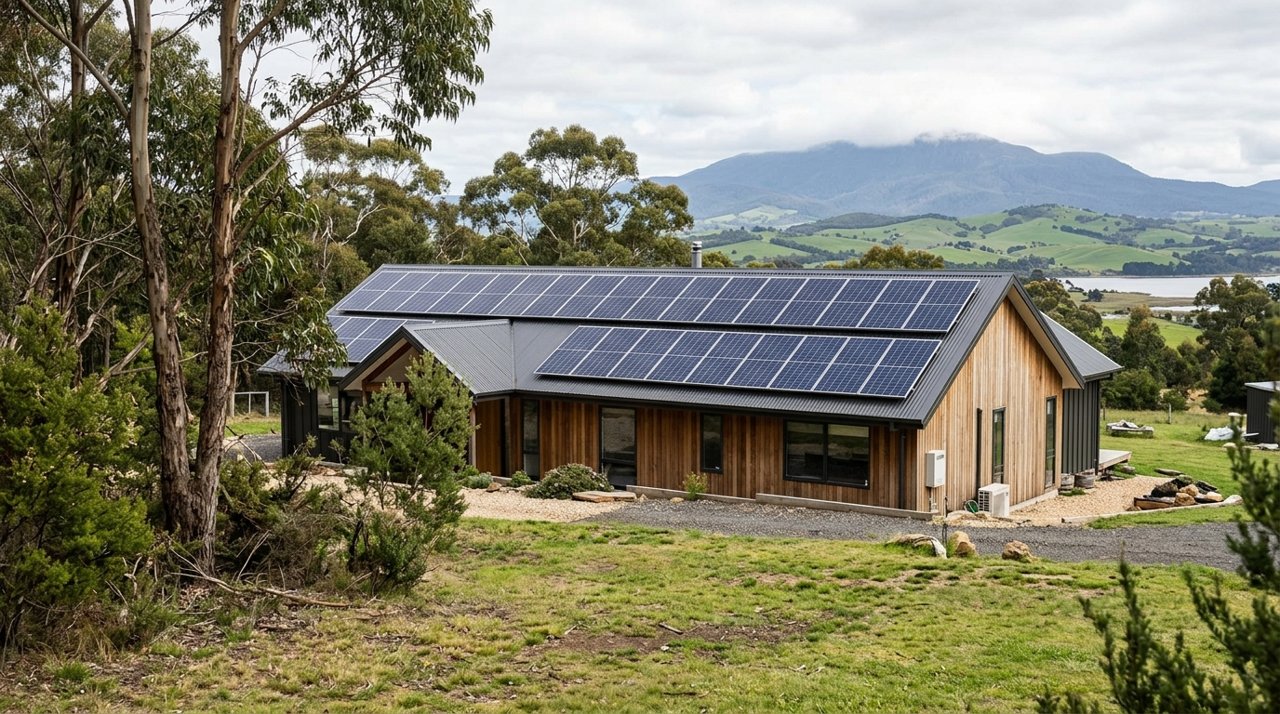
A typical Tasmanian roof — the kind you see across Hobart, Launceston and most regional towns — usually has room for somewhere between 20 and 35 solar panels on its usable, sun-facing sections. In plain terms, that’s enough for most homes to run a 10–13 kW system, which is now the sensible default for households planning to electrify. The exact number depends on your roof’s shape, shading and orientation, but the short answer is: almost every standard Tasmanian roof fits more solar than most people expect.
How many panels actually fit on a typical Tasmanian roof?
Most standard Tasmanian homes comfortably fit roughly 20 to 35 panels on their workable roof area — enough for a 10–13 kW system. A single panel takes up only a modest patch of roof (roughly the size of a large door lying flat), so even a fairly ordinary gable roof usually has more than enough suitable space.
What eats into that space, in practice:
- Gables, valleys and hips break a roof into odd-shaped sections that fit fewer panels.
- Chimneys, skylights, flues and vent pipes force gaps in the layout.
- Shading from trees, neighbouring houses or your own chimney can rule out otherwise good sections, especially in winter when the Tasmanian sun sits low.
- Orientation matters: north-facing is ideal, east and west are very workable, and south-facing is usually left empty.
So while the raw roof area might look huge, it’s the usable, shade-free, sensibly oriented area that counts — and on most homes that’s still plenty.
How big a system does that actually make?
A roof that fits 20-odd panels typically supports something around an 8–10 kW system, and one that fits closer to 30 panels supports roughly 13 kW. Panel wattages vary between models, so exact panel counts shift a little, but the pattern holds: most Tasmanian roofs can host what is now considered a full-size residential system.
Here’s a simple way to think about the common sizes (panel counts are approximate and depend on the panel model used):
| System size | Approximate panel count | Typically suits |
|---|---|---|
| ~6.6 kW | ~15–18 panels | Lower-use homes with no big electrification plans |
| ~10 kW | ~22–26 panels | Average households with growing daytime use |
| ~13 kW (on a 10 kW inverter) | ~28–32 panels | Homes planning an EV, heat pump or induction cooking |
The 13 kW option works because of a standard design rule: you can fit about 133% of panel capacity relative to the inverter size — so roughly 13 kW of panels on a 10 kW inverter. Panels rarely all produce at full tilt at once (cloud, winter sun angles, temperature), so the “oversized” array just means the inverter runs closer to its rated output for more of the day.
Is a 13 kW system too big for my home?
For most homes that plan to electrify, no — around 13 kW is the smart, future-proof default rather than overkill. An EV, a heat pump and an induction cooktop can each add meaningful demand, and having the panel capacity in place from day one is usually far cheaper than expanding later.
There’s also a Tasmanian pricing reality that matters here. Aurora Energy’s regulated feed-in tariff is modest — 9.276 c/kWh from 1 July 2026, up from about 8.9 c — while the power you buy costs roughly 28–30 c/kWh. That gap means the real value of solar is in using your own power, not exporting it. A bigger array gives you more of your own cheap energy to run appliances, heat water and charge a car during daylight hours.
That said, honesty matters: if your household uses very little power and you have no battery, EV or electrification plans, a smaller system may suit you better. Solar should match the home, not the other way around.
Do I need three-phase power in Tasmania?
Usually not. TasNetworks allows a 10 kW single-phase inverter in Tasmania, so most homes can run a full-size system — including the 13 kW panel setup described above — on their existing single-phase connection.
That’s good news for older Tasmanian homes, since upgrading to three-phase can add cost and complexity that simply isn’t necessary for a typical residential install.
What about batteries — do they stack up in Tasmania?
Batteries can make sense, but Tasmania’s relatively cheap power and fair feed-in tariff mean they generally pay back more slowly here than on the mainland. As a broad guide, many households see solar pay for itself in the order of four to six years, while the battery portion often takes noticeably longer — commonly in the range of seven to twelve years — depending on usage patterns, tariffs and installed cost.
The main price support is federal: the Cheaper Home Batteries Program, running since 1 July 2025, takes roughly 30% off an eligible battery (around $250 per usable kWh in 2026 at the full rate for the first 14 kWh, then 60% for 14–28 kWh and 15% for 28–50 kWh, capped at 50 kWh). The discount tapers each year to 2030, the battery must be paired with solar, and eligibility depends on the product and installation meeting the program’s rules. There is no separate Tasmanian state battery rebate.
A few other honest points:
- No vendor or retail VPP program currently operates in Tasmania, so don’t count on virtual power plant payments here.
- Wholesale price exposure does exist through spot-passthrough retail plans, and automated battery control can charge when spot prices go very low or negative and avoid peak imports — though that suits engaged households comfortable with a variable tariff.
- For a typical household on a standard Aurora tariff, a battery’s value is mainly self-consumption plus outage backup — and the backup peace of mind is genuinely worth something in parts of Tasmania prone to outages.
How do shade, orientation and roof shape change the answer?
They can move the practical panel count up or down by quite a lot, which is why any real number for your home needs someone to actually look at the roof — the figures here are a starting point, not a quote. A clear, north-facing roof section with no trees will take more usable panels than a cut-up roof with winter shading, even if both homes look similar from the street.
A few quick self-checks before you go further:
- Look at your roof in mid-morning and mid-afternoon — where does shade actually fall, especially in winter?
- Note the biggest unbroken roof sections and which way they face.
- Check your switchboard and meter box age, as older setups sometimes need work.
- Think about your next five to ten years: EV? Heat pump? Growing family? Size the system for where you’re heading, not just today.
What’s the practical takeaway?
For most Tasmanian homes, the answer is reassuring: your roof almost certainly fits a modern, full-size solar system — commonly 20 to 35 panels, or roughly 10–13 kW — without needing three-phase power. The sweet spot for most households is around 13 kW of panels on a 10 kW inverter, sized for the electric home you’re likely to become, while smaller systems still make sense for genuinely low-use homes with no electrification plans.
Because Tasmania’s feed-in tariff is modest compared with the retail price of power, the households who get the most from solar are the ones who use their own generation — run the dishwasher and hot water in the sun, charge the car at lunchtime, pre-heat the house in the afternoon. And since every roof, tariff and household is different, treat every figure in this guide as a general indication rather than a promise, and get your specific roof and usage properly assessed before committing.
This guide was written by the Tasmanian solar team at Solar Generation Tasmania as a free community resource — if you’re ever puzzling over panels, batteries or tariffs, we’re always happy to answer questions and point you in the right direction.
#solargentas #solargen #solargenerationtasmania
Published by Solar Generation Tasmania. General information current as at publication — rebates, tariffs and prices change, so confirm current figures before deciding.
Thinking about solar for your place?
Tell us a little about your home and a local Tasmanian installer will put together a free, no-obligation assessment — system, battery and the rebates you qualify for.
- Honest advice for Tasmanian conditions (Zone 4 sun, hydro grid)
- We apply every rebate you’re eligible for
- Local installers — not a mainland call centre
- SAA-accredited, with degree-qualified owners and 10+ years in tech & solar