
← Blog · 8 October 2026
Home Wind Turbines in Tasmania: Recent Developments and Whether They Make Sense
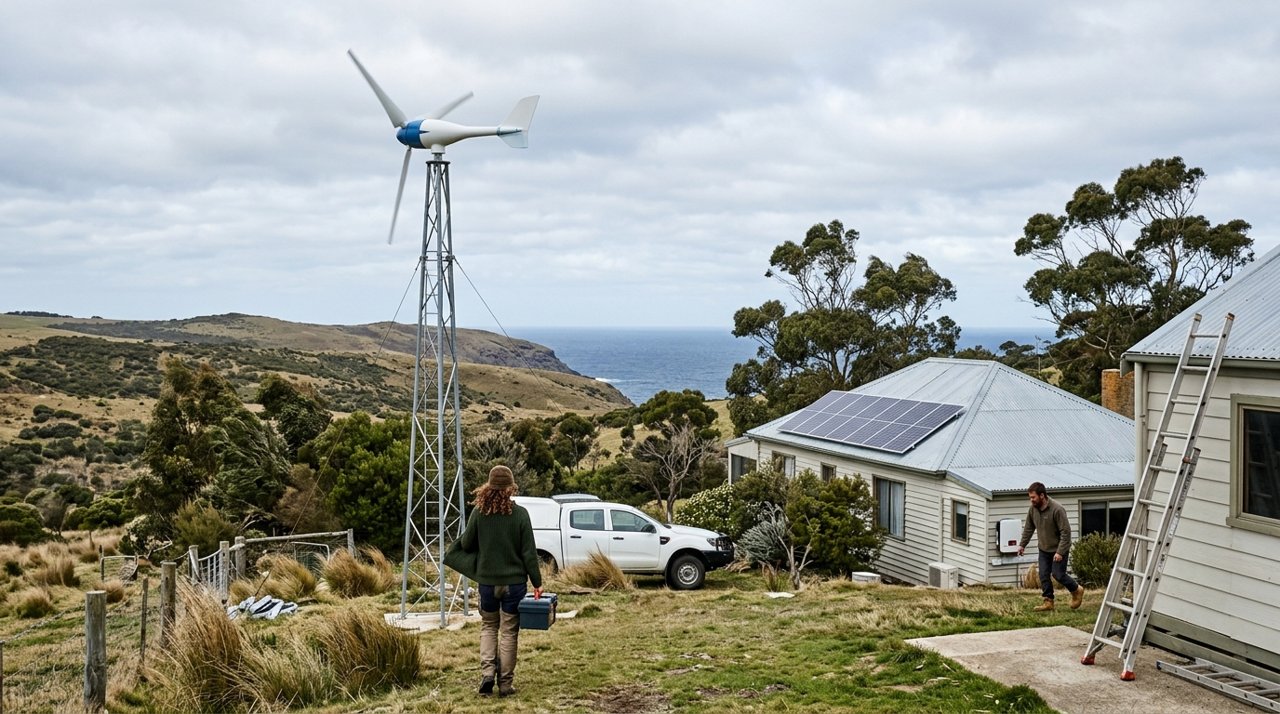
Wind is part of everyday life in Tasmania. We live downwind of the Roaring Forties, we watch the big turbines spin on the north-west coast, and it’s a fair question to ask: if wind works so well at scale here, why not put a small turbine in the back paddock?
It’s a question we get often enough that it’s worth a proper update. We looked at this in Why Wind Power Is Difficult — and Why Solar Usually Wins for Tasmanian Homes, and the conclusion hasn’t changed. What has changed is the technology on offer and the marketing around it — so here’s what’s new, and the narrow set of Tasmanian properties where small wind genuinely deserves a look.
What’s new in home wind turbines in 2026?
Several new designs, but very little new independent evidence. The interesting developments are real engineering efforts; what’s missing is field data from someone other than the manufacturer. Treat performance claims as unproven until that exists.
The three categories people ask about:
- “Bladeless” oscillating turbines — slim masts that vibrate in the wind rather than spinning. We could find no public independent performance data.
- Rooftop-edge units — modules that sit along the parapet of a building and use the airflow pushed up its face. These are designed for large industrial and commercial buildings, not houses, and went through prototype testing in Denmark in 2024–25.
- Spiral and helical rooftop turbines — visually appealing, and the output claims are based on simulations and wind-tunnel testing. We found no independent field data.
The honest summary: interesting designs, promising claims, very little independent proof yet. Nothing here overturns the physics below.
How much wind do you actually need?
More than most Tasmanian homes have at roof height. The Australian Government’s Your Home guide says off-grid small wind systems need an average wind speed of at least 4–5 m/s, and grid-connected systems need more than 6 m/s. Below that, a turbine spins and looks productive while producing very little.
Two facts do most of the work in this decision:
Output rises with the cube of wind speed. Double the wind speed and you get roughly eight times the energy. Small differences in siting swing the result enormously.
Height matters as much as location. Your Home gives the example of a site averaging 5 m/s at 30 metres being about 3 m/s at 12 metres. The wind speed that counts is the one at your planned tower height — not at ground level, and not the regional average.
Your Home is also blunt on two points: urban wind is extremely turbulent, and roof-mounted turbines are never economically sound. Turbulence doesn’t just cut output; it loads the machine badly and wears it out.
What does real-world data show about small turbines?
The best independent field evidence remains two UK trials from 2009 — we found no newer independent trial. Both compared actual output against what the sites were predicted to produce, and the gap was large.
| Energy Saving Trust trial (57 turbines) | Warwick Wind Trials (26 turbines) | |
|---|---|---|
| Mounting | Free-standing and roof-mounted | Roof-mounted |
| Average capacity factor | 19% for free-standing turbines | 0.85% |
| Key finding | Free-standing produced about six times as much as roof-mounted; roof-mounted sites averaged under 4 m/s | Standard wind-speed predictions overestimated output by 15 to 17 times |
That contrast — 19% versus 0.85% — is the whole argument. A well-sited turbine on a tall free-standing tower can do real work. The same machine bolted to a house is close to decorative.
Doesn’t Tasmania’s wind change the maths?
Only in specific places. The west and north-west coasts sit in the Roaring Forties, and the big wind farms there achieve high output — roughly a 40% capacity factor. But those turbines have hubs 60 to 137 metres up, in smooth, fast air far above anything a household tower reaches.
Sheltered suburbs, valleys, and sites behind trees or buildings get far less. A Hobart or Launceston backyard is a very different wind resource from an exposed coastal ridge, even a few kilometres away.
So don’t rely on a town average, and don’t rely on a supplier’s map. Measure your own site — ideally at the planned tower height, over a full year — before you spend anything. Wind varies by season, and a summer month tells you little.
Is there a rebate for home wind in Tasmania?
Small wind can earn Small-scale Technology Certificates under the federal Small-scale Renewable Energy Scheme, which discounts the upfront cost. Based on the published scheme rules, eligibility generally requires the system to be under 10 kW, generate under 25 MWh a year, and be designed and installed by a person accredited through Solar Accreditation Australia.
Worth knowing: wind and hydro together account for under 0.02% of all STCs created. Uptake is tiny, which tells you something about how the numbers usually land.
Do you need a council permit?
Possibly not — but only if you meet every exemption condition. Under the Tasmanian Planning Scheme a small turbine can be exempt from requiring a permit where all the conditions are satisfied, including:
- One turbine per lot
- Not closer to the street frontage than an existing building
- At least 15 m from side and rear boundaries
- Height excluding blades of no more than 20 m in rural, agriculture and industrial-type zones, and no more than 12 m elsewhere
- At least 60 m from a neighbour’s house or other sensitive use, for a turbine of 10 kW or less
- No heritage, airport, landslip or other code trigger
Note the 12 m suburban height limit sitting next to the physics above: in most suburban zones, the exemption caps you at a height where the wind is often too slow and too turbulent to be worth it. Always confirm the current rules with your local council first.
For grid connection, TasNetworks handles small wind through its embedded-generation connection process and requires an inverter compliant with AS/NZS 4777.2:2020.
Where can small wind actually make sense?
Your Home notes most small wind systems in Australia are off-grid, usually paired with solar, and that grid-connected wind with a battery is uncommon. Its example: a 1 kW turbine at a 5 m/s average supplies about a quarter of the needs of a home using 5,000 kWh a year — a useful contribution, not a whole solution.
The realistic Tasmanian candidate looks like this:
- Exposed rural, coastal or ridge-top property
- Measured strong, steady wind at tower height, over a full year
- Room for a tall free-standing tower, well clear of buildings and trees
- Off-grid or poor grid supply, where wind complements solar through still-sun, windy winters
If that’s not you, more panels plus a battery almost certainly deliver more energy per dollar.
Wind or more solar panels?
For most Tasmanian homes, solar. Panels have no moving parts, predictable output, straightforward approvals, and a far larger body of local evidence behind them.
The economics here reward using your own power rather than exporting it. The regulated feed-in tariff rises to 9.276 c/kWh from 1 July 2026, while importing costs roughly 28–30 c/kWh — so every kWh you use yourself is worth about three times an exported one. That’s why around 13 kW of panels on a 10 kW inverter (the 133% oversizing rule) has become the sensible default for homes planning an EV, heat pump or induction cooktop, and why TasNetworks allowing a 10 kW single-phase inverter means most homes don’t need three-phase. A very low-use home with no battery, EV or electrification plans may be better served by something smaller.
Typical quoted payback ranges for solar are commonly in the order of several years, and longer again for a battery portion — but your result depends entirely on your usage, tariff and site, so treat any figure as an estimate to be checked against your own bills.
On tariffs, a quick orientation, because they’re widely misdescribed:
- Tariff 93 (residential time-of-use) is the default — every new or upgraded residential connection has been assigned to it since 1 July 2024. Whole-of-home, peak weekdays 7–10am and 4–9pm (8–11am and 5–10pm during daylight saving), everything else off-peak including all weekend.
- Tariffs 31 and 41 are the legacy pair, closed to new installations on 30 June 2024. Neither is time-of-use; Tariff 41 is the separately metered controlled load for hard-wired heating and hot water.
- Tariff 97 is the newer opt-in CER tariff for homes with solar, a battery or an EV. It’s the only one with a super off-peak rate (midnight–4am every day, weekends included), its peak runs weekdays 7–10am and 4–10pm, and it carries an excess demand charge above 8.5 kW. Whether you can get it depends on your retailer.
On batteries: the federal Cheaper Home Batteries Program takes around 30% off the cost of an eligible battery, subject to the scheme’s eligibility rules, and the battery must be paired with solar. The discount tapers each year to 2030. There’s no separate Tasmanian state battery rebate, and we’d rather be straight with you — Tasmania’s relatively cheap power and fair feed-in tariff mean a battery generally pays back more slowly here than on the mainland. No vendor VPP program operates in Tasmania, though wholesale-price exposure is available through spot-passthrough retailing, and automated control can charge a battery when spot prices go negative and avoid peak-period imports. We run exactly that on our own systems. For a household on standard Aurora tariffs without spot exposure, the value is self-consumption plus backup during outages.
The practical takeaway
If you’re genuinely curious about wind on an exposed rural block, do this before spending a cent: put up a logging anemometer at your planned hub height and leave it there for a full year. Compare the measured average against the 6 m/s that Your Home nominates for grid-connected systems, remembering the cube law — a site that measures 5 m/s instead of 6 produces roughly half as much. That one year of data will tell you more than any brochure, and it costs a tiny fraction of a turbine.
And if the answer comes back “not enough wind”, that’s not a dead end. It just means your roof is the better place to put the money.
This guide is written by the Tasmanian solar team at Solar Generation Tasmania. We’re happy to answer questions from anyone working through these decisions — no strings attached.
#solargentas #solargen #solargenerationtasmania
Published by Solar Generation Tasmania. General information current as at publication — rebates, tariffs and prices change, so confirm current figures before deciding.
Thinking about solar for your place?
Tell us a little about your home and a local Tasmanian installer will put together a free, no-obligation assessment — system, battery and the rebates you qualify for.
- Honest advice for Tasmanian conditions (Zone 4 sun, hydro grid)
- We apply every rebate you’re eligible for
- Local installers — not a mainland call centre
- SAA-accredited, with degree-qualified owners and 10+ years in tech & solar