
← Blog · 25 August 2026
Choosing a Solar Installer in Tasmania: What to Look For for Tasmanian Households
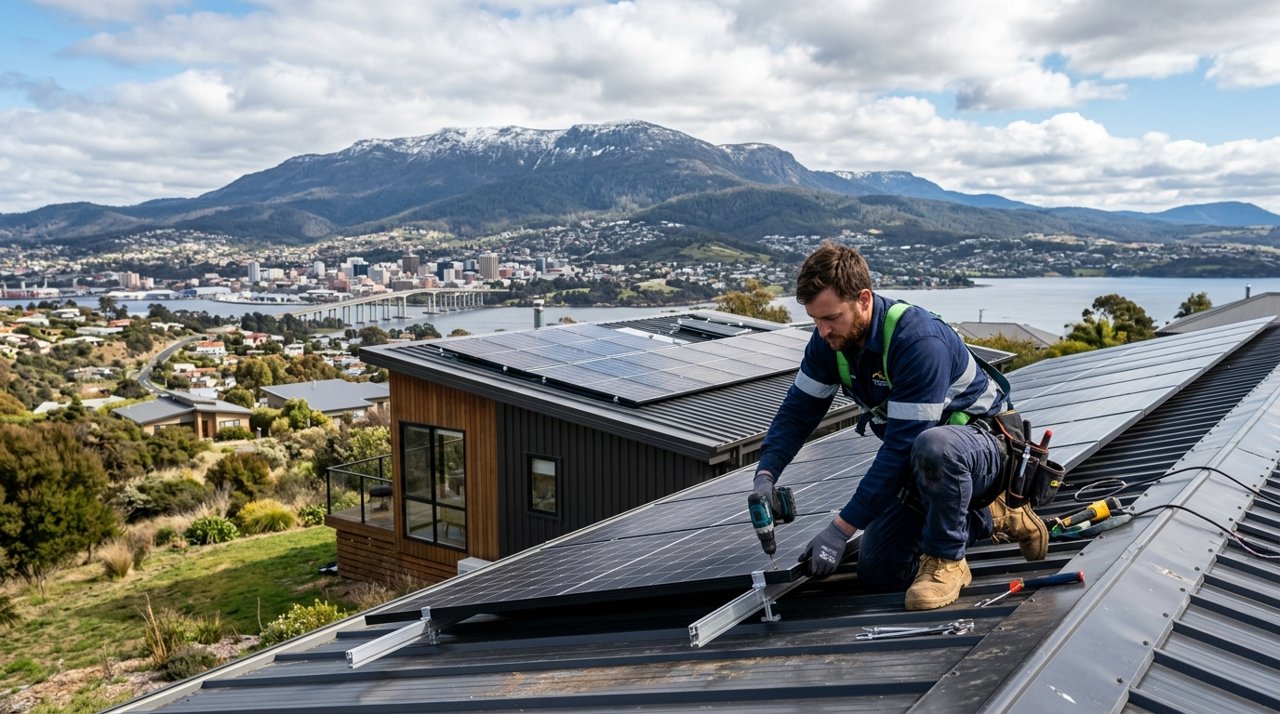
Tasmania is not the mainland. Our power prices, our weather, our grid rules and our rebates all work a little differently, so solar advice written for Sydney or Melbourne often doesn’t fit a home in Hobart, Launceston or the regions. This guide walks through what actually matters when choosing an installer and a system here, using Tasmanian tariffs and settings as they stand in 2026 — so you can make your own decision with confidence.
How do I choose a solar installer I can trust?
Look for an established local installer with a real track record in Tasmanian conditions, accredited designers and installers, itemised quotes naming exact panel and inverter models, and a willingness to explain — not just sell. Ask who actually does the work, and how warranty claims are handled after install day.
A few things worth digging into before you sign anything:
- Local experience. Tasmanian roofs cop wind, coastal salt air and long, low-light winters. An installer who works here every day will design for that.
- Who’s on the roof. Ask whether the crew is in-house or subcontracted, and who you call if something needs attention in five years.
- Accreditation. Systems generally need to be designed and installed by properly accredited professionals for you to access the federal rebate — ask to see credentials.
- A real quote. It should list brands and model numbers, the panel layout, and what happens if your switchboard or meter needs upgrading.
What size system suits a Tasmanian home?
For most households planning to electrify — an EV, a heat pump, induction cooking — around 13 kW of panels on a 10 kW inverter is a sensible, future-proof default. The old 6.6 kW standard still suits smaller, low-use homes with no electrification plans.
Why the step up? Panel capacity is allowed to exceed the inverter rating by up to a third under the national rules, which is why roughly 13 kW of panels pairs so well with a 10 kW inverter. Panels are the cheap part of the system; the inverter, labour and cabling are much the same either way. Sizing up now means your roof is ready when an EV or heat pump arrives, rather than paying for a second install later.
Be honest with yourself, though: if your household uses very little power, has no battery or EV plans, and isn’t looking to electrify, a smaller system may serve you better. Bigger is only smarter if you’ll actually use the extra generation.
Do I need three-phase power for a bigger system?
Usually, no. TasNetworks allows a 10 kW inverter on a standard single-phase connection in Tasmania, so most homes can run a generous system without the cost and hassle of a three-phase upgrade.
That’s a genuine Tasmanian advantage — in some mainland states, single-phase homes are capped at much smaller inverters. Your installer should confirm the details for your specific connection as part of the quote.
Why does self-consumption matter more than the feed-in tariff?
Because the maths strongly favours using your own solar. At the time of writing, the regulated feed-in tariff from Aurora Energy — the main residential retailer — sits at 9.276 cents per kWh from 1 July 2026 (up from about 8.9 cents), while buying power from the grid costs roughly 28–30 cents per kWh.
In plain terms: every unit of solar you use yourself avoids paying around three times what you’d earn exporting that same unit. So the savings live in self-consumption, not export. Practical ways to lift it:
- Run the dishwasher, washing machine and dryer in the middle of the day.
- Put hot water heating on a daytime timer or divertor.
- Set heat pumps to pre-heat or pre-cool while the sun’s out.
- If an EV is in your future, plan for daytime charging where possible.
This is also why “how much will I save?” has no honest single answer — it depends on how much of your own solar you can use, your tariff, your roof and your final installed price. Many Tasmanian households see the solar portion pay for itself in roughly four to six years, but your figure could sit either side of that depending on those factors.
What rebates can Tasmanian households access?
Two federal programs do the heavy lifting, and there is no separate Tasmanian state battery rebate. The STC scheme discounts the upfront cost of solar, and the national battery program takes roughly 30% off an eligible battery — always subject to each program’s eligibility rules.
- STC rebate (solar). The federal Small-scale Renewable Energy Scheme effectively discounts your system price, usually applied directly on the quote. Tasmania sits in STC Zone 4, and eligibility depends on accredited installation and approved equipment.
- Cheaper Home Batteries Program (from 1 July 2025). For eligible batteries paired with solar, the discount works out to roughly $250 per usable kWh in 2026 at the full rate for the first 14 kWh, stepping down to 60% of that rate for 14–28 kWh and 15% for 28–50 kWh, capped at 50 kWh. The discount tapers each year through to 2030, so earlier is generally more generous — provided your battery and setup meet the program rules.
Is a battery worth it in Tasmania?
Honestly? Slower to pay back here than on the mainland, because Tasmania’s power is comparatively cheap and the feed-in tariff is fair. For a typical household on a standard tariff, a battery’s value is mostly extra self-consumption plus blackout backup, and payback periods often land somewhere in the seven-to-twelve-year range depending on usage, system size and installed price.
There are nuances worth knowing. No vendor or retail VPP program currently operates in Tasmania, so you can’t sign up for one of those mainland-style virtual power plant schemes. What does exist is wholesale spot-price exposure: some retailers pass through live market prices, and an automated battery can charge when spot prices go very low or negative and avoid buying at peak times. Solar Generation runs exactly this kind of automated control on its own systems, so the concept is proven locally — but it only suits households comfortable with a spot-linked tariff. If backup during outages matters to you, that’s a real benefit regardless of payback maths.
What should I ask before signing a quote?
Ask every installer the same questions and compare the answers side by side. Vague or evasive answers are your cue to keep looking.
| Question | What a good answer sounds like |
|---|---|
| Who designs and installs my system? | Named, accredited people — ideally in-house |
| What exact equipment am I getting? | Panel and inverter brands and model numbers in writing |
| How did you size this system? | Based on your actual usage data, not a generic package |
| How do warranties work? | Clear process for product and workmanship claims, handled locally |
| What’s excluded from the price? | Honest list: switchboard upgrades, meter work, difficult roofs |
| What monitoring do I get? | An app or portal so you can see generation and usage |
What’s the smartest next step?
Start with your own numbers, not a salesperson’s. Pull a year of power bills, note your daily usage and tariff, think about whether an EV, heat pump or battery is on your horizon, then talk to more than one installer and compare like-for-like quotes on equipment, size and warranty. The best solar decisions in Tasmania are unhurried ones: size for where your household is heading, prioritise using your own solar, and treat any rebate as a bonus that depends on eligibility — never a guarantee.
This guide was written by the Tasmanian solar team at Solar Generation Tasmania — locals who are always happy to answer questions and help you make sense of your options.
#solargentas #solargen #solargenerationtasmania
Published by Solar Generation Tasmania. General information current as at publication — rebates, tariffs and prices change, so confirm current figures before deciding.
Thinking about solar for your place?
Tell us a little about your home and a local Tasmanian installer will put together a free, no-obligation assessment — system, battery and the rebates you qualify for.
- Honest advice for Tasmanian conditions (Zone 4 sun, hydro grid)
- We apply every rebate you’re eligible for
- Local installers — not a mainland call centre
- SAA-accredited, with degree-qualified owners and 10+ years in tech & solar