
← Blog · 6 September 2026
Battery Storage vs a Bigger Solar Array in Tasmania: Which First?
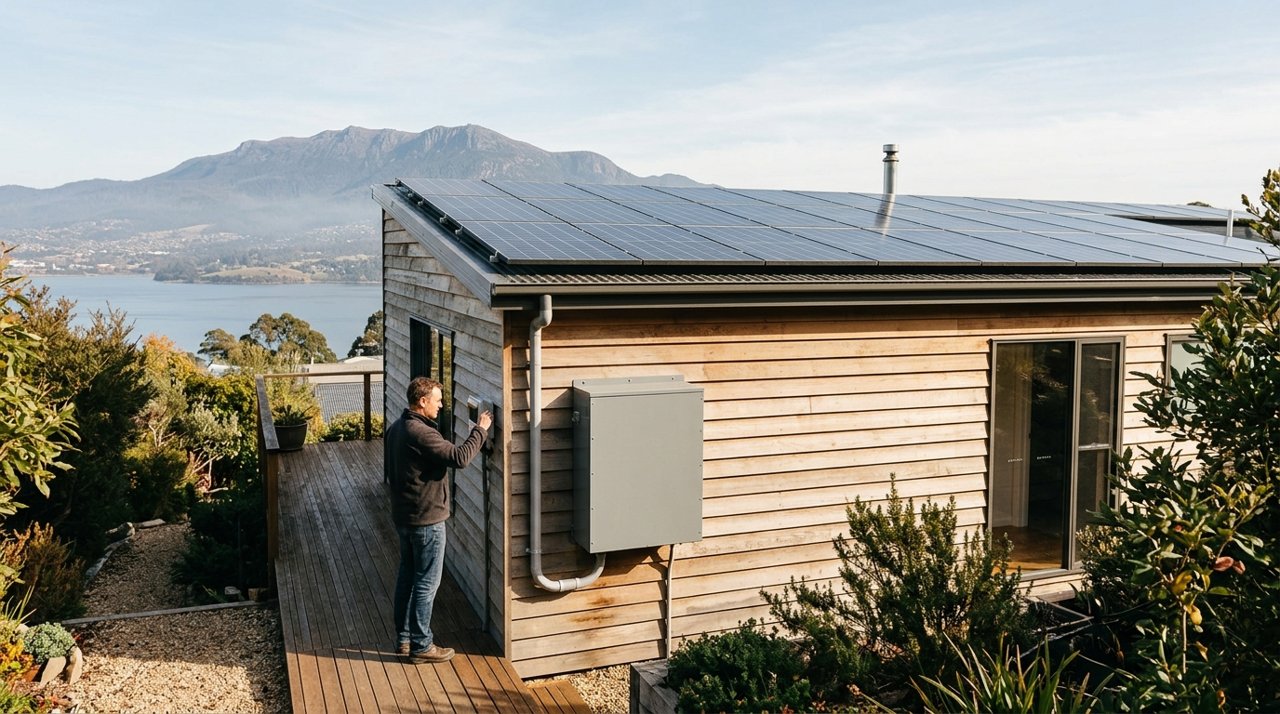
If you’re weighing up battery storage against a bigger solar array, here’s the short answer for most Tasmanian homes: get the solar right first — and size it generously — then add a battery once your household is ready to use it. Panels do most of the heavy lifting on your power bill; a battery is usually the second act, not the opener. Here’s why, and how to tell when the order flips.
Should I buy a battery or a bigger solar array first?
For most Tasmanian households, a bigger solar array comes first. Solar panels are generally the more cost-effective way to cut your bill per dollar spent, while a battery tends to make the most sense once you have enough generation to fill it and enough evening usage to benefit from it. There are genuine exceptions — homes in blackout-prone areas, for example — which we cover below.
The reason comes down to how the money actually flows on a Tasmanian power bill.
Why is using your own solar power worth more than exporting it?
In Tasmania, solar power you use yourself is worth roughly three times as much as power you export. Aurora Energy’s regulated feed-in tariff is 9.276 c/kWh from 1 July 2026 (up from about 8.9c), while households commonly pay around 28–30 c/kWh for grid electricity — so every unit you self-consume avoids the much higher import price.
This one fact shapes the whole battery-versus-panels decision:
- A bigger array that runs your daytime appliances, hot water, heat pump or EV charging replaces expensive grid power directly.
- A battery is essentially a tool for moving solar energy from midday to evening — it converts export-priced energy into self-consumption-priced energy.
Both are worthwhile, but the array is what creates the cheap energy in the first place. Without enough panels, a battery has little to store.
How big should my solar system be in Tasmania?
For most homes planning to electrify — an EV, a heat pump, induction cooking — around 13 kW of panels on a 10 kW inverter is a sensible, future-proof default. TasNetworks permits a 10 kW inverter on single-phase in Tasmania, so most homes do not need an expensive three-phase upgrade. Smaller systems still suit genuinely low-use households.
A few points worth knowing:
- The old 6.6 kW “standard” system was sized for yesterday’s homes. If you expect to own an EV or switch heating and cooking to electric over the next decade, sizing up now is usually cheaper than adding panels later.
- The roughly-13 kW figure comes from the common rule allowing panel capacity up to about 133% of inverter capacity — about 13 kW of panels on a 10 kW inverter.
- The federal STC rebate (part of the Small-scale Renewable Energy Scheme) discounts the upfront cost of the system. Tasmania sits in STC Zone 4, and the rebate applies at the time of installation — your installer normally handles the paperwork.
One honest caveat: if your household uses very little power and you have no battery, EV or electrification plans, a smaller system may suit you better. Bigger is only smarter if you’ll actually use the energy.
Is a battery worth it in Tasmania yet?
Honestly, batteries pay back more slowly in Tasmania than on the mainland, because our electricity is relatively affordable and the feed-in tariff is fair. For a typical household on a standard Aurora tariff, a battery’s value is mainly extra self-consumption plus blackout backup — so it suits high evening users and outage-prone areas first.
That said, the economics have improved:
- The federal Cheaper Home Batteries Program (running since 1 July 2025) takes roughly 30% off an eligible battery — around $250 per usable kWh in 2026 at the full rate for the first 14 kWh of capacity, with reduced rates for larger batteries (60% of the full rate for 14–28 kWh and 15% for 28–50 kWh, up to a 50 kWh cap). The discount tapers each year through to 2030, the battery must be paired with solar, and eligibility conditions apply — so treat any figure as indicative, not guaranteed.
- There is no separate Tasmanian state battery rebate.
- No retail VPP (virtual power plant) program currently operates in Tasmania. However, wholesale-price exposure does exist here through spot-passthrough retailing, and automated battery control can charge when spot prices go negative and avoid peak-price imports — Solar Generation runs exactly this approach on its own systems.
For a typical Aurora-tariff household without spot exposure, though, the honest maths is: self-consumption plus the peace of mind of backup power.
What do the numbers roughly look like side by side?
Every home is different, so treat these as general guideposts rather than promises — actual costs, savings and payback depend on your usage, roof, tariff and installer:
| Bigger solar array | Battery storage | |
|---|---|---|
| What it does | Generates cheap daytime power | Shifts solar into the evening |
| Indicative payback | Commonly around 4–6 years, depending on usage, orientation and tariff | Often around 7–12 years, depending on tariff and how well it’s used |
| Upfront help | Federal STC rebate (Tasmania is Zone 4) | Cheaper Home Batteries Program (~30% off eligible batteries, conditions apply) |
| Best for | Cutting bills, preparing for EV/heat pump | High evening use, blackout backup, spot-price exposure |
| Watch-outs | Roof space and shading; unused export earns less | Slower payback in Tasmania; must be paired with solar |
When should the battery come first?
The usual “solar first” order flips when:
- You cop regular blackouts and backup power matters more than bill savings.
- You already have a decent solar array and export plenty during the day.
- Your evenings are energy-hungry — heating, cooking, EV charging after dark.
- You’re on (or considering) a spot-passthrough tariff with automated battery control, where charging on cheap or negative prices adds extra value.
So what’s the practical takeaway?
For most Tasmanian homes, the smart sequence is: install a generously sized solar array first — around 13 kW if you plan to electrify — and have it designed battery-ready. Live with it for a season or two, watch how your usage and exports actually behave, then add a battery when the numbers suit your household. Because the federal battery discount tapers each year to 2030, households who’ll benefit from storage generally capture more of the rebate by acting sooner rather than later — but only once the solar underneath it is doing its job.
This guide was written by the Tasmanian solar team at Solar Generation Tasmania — locals who are always happy to answer questions and help you make sense of your options.
#solargentas #solargen #solargenerationtasmania
Published by Solar Generation Tasmania. General information current as at publication — rebates, tariffs and prices change, so confirm current figures before deciding.
Thinking about solar for your place?
Tell us a little about your home and a local Tasmanian installer will put together a free, no-obligation assessment — system, battery and the rebates you qualify for.
- Honest advice for Tasmanian conditions (Zone 4 sun, hydro grid)
- We apply every rebate you’re eligible for
- Local installers — not a mainland call centre
- SAA-accredited, with degree-qualified owners and 10+ years in tech & solar