
← Blog · 3 October 2026
Are Solar Panels Going to Get More Efficient? What It Means for Tasmanian Buyers
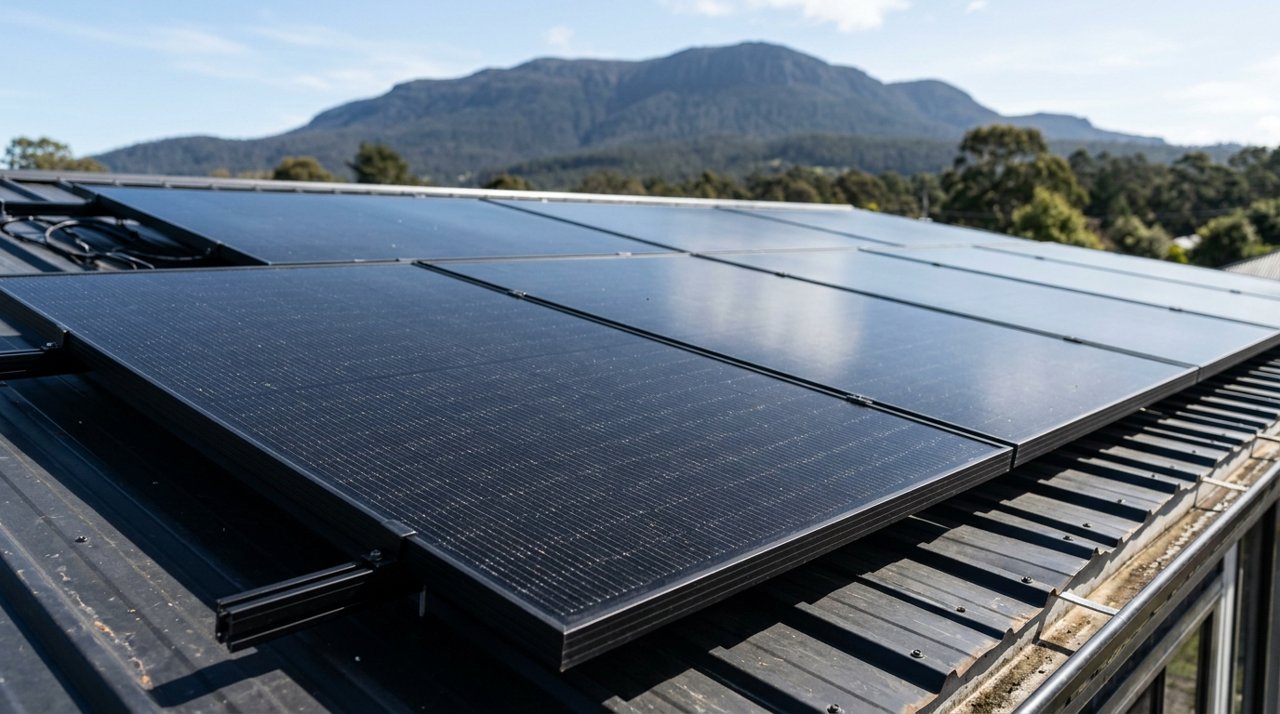
Short answer: yes, but slowly, and the pace of improvement has changed. Panel efficiency is no longer leaping forward the way it did a decade ago — it’s grinding upward a fraction of a percent at a time, while the big jumps are happening in laboratories rather than on rooftops. For a Tasmanian household, that means waiting for “next year’s panels” is rarely the deciding factor.
Here’s what’s actually happening, and what it means if you’re weighing up solar in Hobart, Launceston or regional Tas.
How efficient are the solar panels being installed in 2026?
Most panels going on Australian roofs in 2026 sit in the low-to-mid 20s. TOPCon panels — the current mainstream — are roughly 21–24% efficient, heterojunction (HJT) panels around 22–24%, and back-contact designs reach up to about 25%.
The shift has been quick. Panels above 22.5% efficiency made up 53% of tracked products by mid-2026, up from just 16% in January 2024. So the “good” panel of two years ago is now simply average.
| Panel type | Typical efficiency in 2026 | Where you’ll find it |
|---|---|---|
| TOPCon | about 21–24% | the mainstream choice on most quotes |
| Heterojunction (HJT) | about 22–24% | premium tier |
| Back-contact | up to about 25% | premium tier, small or tight roofs |
| Perovskite-on-silicon tandem | lab and pilot only | not available for Australian homes |
What’s the highest solar efficiency ever recorded?
The record for a single-junction silicon solar cell is 28.29%, certified by Germany’s ISFH institute and announced on 24 September 2026 — narrowly beating 28.13% set earlier in the same year.
A record cell is not a record panel, though. The best full-size silicon module (1.9 square metres) sits at 26.4%, certified by the US National Laboratory of the Rockies, formerly NREL. That gap between a postage-stamp cell in a lab and a real panel on a roof is where most of the hype gets lost.
Is there a ceiling on silicon panel efficiency?
Yes — and we’re very close to it. The practical maximum for a single-junction silicon cell is about 29.4%, which means the 28.29% record cell is already around 96% of the way there. The theoretical ceiling for any single-layer cell, known as the Shockley–Queisser limit, is 33.7%.
In plain terms: silicon has almost run out of room. Future gains from silicon alone will be slivers, not strides.
What about perovskite tandem panels — are they the next big thing?
Tandem panels stack two light-absorbing layers so each captures a different part of the spectrum, which lets them sail past the single-layer limit. The record perovskite-on-silicon tandem cell is 35.5%, certified by the European Commission’s Joint Research Centre and announced in July 2026, up from 34.85% in April 2025. In the lab, tandem modules have reached 29.4% on a 1.7 square-metre module.
Those are genuinely exciting numbers. The catch is getting them onto a roof for 25 years.
- A UK company made the first commercial shipment of tandem panels in September 2024 — 24.5% modules for a US utility project.
- In January 2026 that same company still described its output as pilot products, targeting mass production in 2027 and a 20-year lifetime.
- In June 2026, the world’s largest panel maker said it had no active plan to mass-produce tandem panels.
- The open question is durability: the perovskite layer’s long-term stability is still being proven.
No tandem panels were found for sale to Australian homes. If you’re hoping to buy them for your place in Kingston or Devonport, that option isn’t on the table yet.
Does a more efficient panel mean cheaper power?
Not directly. Higher efficiency means more watts squeezed out of the same roof area — it doesn’t by itself make each kilowatt-hour cheaper.
Efficiency matters most when roof space is the constraint: a small roof, a shaded roof, or a fiddly one with dormers, vents and multiple orientations. If you’ve got a big north-facing expanse, you can usually reach the same system size with slightly less efficient panels and spend the difference on a better inverter or a neater install.
On most roofs, these matter more than an extra percent or two:
- Price per watt
- The performance warranty (almost all panels carry a 25-year performance warranty — a common example is 90% of output at 10 years and 80% at 25 years)
- The inverter
- Installation and mounting quality, which in Tassie also means wind and weather
What about panel prices — are they still falling?
They’ve fallen a long way, then bounced off the bottom. Wholesale TOPCon panel prices were roughly US$0.185–0.215 per watt in July 2023, crashed to record lows of about US$0.07–0.09 per watt across 2024 and early 2025, and sat around US$0.11 per watt in 2026 — still about 40% below 2023, but above the low point.
So the “panels keep getting cheaper forever” story has paused. Waiting purely for a lower panel price is a weaker bet in 2026 than it was in 2024.
Should I wait for better panels before going solar in Tasmania?
For most Tasmanian households, no — because the efficiency gains ahead are incremental, and every month you wait is a month of savings you don’t get back. A panel installed today keeps producing for decades.
What actually moves the numbers here isn’t the panel spec sheet — it’s how much of your own generation you use. The regulated Aurora Energy feed-in tariff is 9.276 c/kWh from 1 July 2026 (up from about 8.8c), while importing power costs roughly 28–30 c/kWh. Every kWh you use yourself is worth around three times what you’d earn exporting it.
That’s why your tariff matters more than your panel brand:
- Tariff 93 is the default residential time-of-use tariff — every new or upgraded connection since 1 July 2024 goes on it. Peak is weekdays 7–10am and 4–9pm (8–11am and 5–10pm during daylight saving); everything else, including all weekend, is off-peak.
- Tariffs 31 and 41 are the legacy flat-rate pair, closed to new installations on 30 June 2024. Existing homes may stay on them. Neither is time-of-use.
- Tariff 97 is the newer opt-in tariff for homes with solar, a battery or an EV. It’s the only one with a super off-peak rate (midnight–4am every day, weekends included). Its peak is weekdays 7–10am and 4–10pm — an hour longer in the evening than Tariff 93 — and it carries an excess demand charge above 8.5 kW. It is not a hot-water or controlled-load tariff; that’s Tariff 41. Whether a Tariff 97 plan is available to you depends on your retailer.
What’s the practical takeaway?
Spend your energy on sizing, not on chasing the spec sheet. A system around 13kW of panels on a 10kW inverter — using the 133% oversizing rule — has become the sensible future-proof default for households expecting to add an EV, a heat pump or induction cooking, and TasNetworks allows a 10kW single-phase inverter in Tasmania, so most homes don’t need a three-phase upgrade. If your use is genuinely low and you have no electrification plans, a smaller system may suit you better.
Federal STC support under the SRES discounts the upfront cost, with Tasmania in STC Zone 4, and the Cheaper Home Batteries Program (from 1 July 2025) can take roughly 30% off an eligible battery if it’s paired with solar and meets the program rules — around $250 per usable kWh in 2026 at the full rate for the first 14 kWh, then 60% for 14–28 kWh and 15% for 28–50 kWh, capped at 50 kWh, and tapering each year to 2030. Eligibility depends on your circumstances and the approved product list, so check before you count on it. There’s no separate Tasmanian state battery rebate.
Be realistic about batteries here: Tasmania’s comparatively cheap power and fair feed-in tariff mean the battery portion typically pays back more slowly than on the mainland, so it’s often more about self-consumption and outage backup than arbitrage. No vendor or retail VPP operates in Tasmania, though wholesale spot-passthrough retailing does exist — and with that, automated control can charge a battery when spot prices go negative and dodge peak imports. We run exactly that setup on our own systems.
Solar in Tasmania generally pays for itself over a handful of years depending on your usage, tariff and shading, with the battery portion taking considerably longer. Panels will keep improving a fraction at a time — the system you design well today will still be a good system when they do.
This guide is written by the Tasmanian solar team at Solar Generation Tasmania. We’re locals who like talking about this stuff, so if something here raises a question about your own place, we’re happy to help you work it out.
#solargentas #solargen #solargenerationtasmania
Published by Solar Generation Tasmania. General information current as at publication — rebates, tariffs and prices change, so confirm current figures before deciding.
Thinking about solar for your place?
Tell us a little about your home and a local Tasmanian installer will put together a free, no-obligation assessment — system, battery and the rebates you qualify for.
- Honest advice for Tasmanian conditions (Zone 4 sun, hydro grid)
- We apply every rebate you’re eligible for
- Local installers — not a mainland call centre
- SAA-accredited, with degree-qualified owners and 10+ years in tech & solar